Nancy Lindisfarne writes: Here we are reposting a short story I originally published in Arabic in 1997. I did anthropological fieldwork in Damascus in the late 1980s, and from day one I saw the tyranny of the regime. But I knew the whole time I was in Syria, and then again when I tried out the stories on friends in Damascus, that for their sake, I could only hint at the fear everyone felt. As you can see here, the most politically explicit of my Syrian stories, ‘Fresh Apricots’, is little more than a bare whisper about a taxi driver picking up a fare on Sednaya Road in Damascus. In 1997, Mamdouh Adwan, the Syrian poet and playwright, translated into Arabic a collection of short stories I had written after my year of fieldwork. Al Raqs fi Dimasq was published in Syria before an English version, Dancing in Damascus, came out in 2000. But though a bare whisper, I also knew Syrian readers absolutely understood what I was trying to say.
Month: February 2021
Renewables and the Market

Jonathan Neale writes: Over the last few years, the falls in the price of solar and wind power have been dramatic. Does this mean the the market will now produce enough renewable energy?
Unfortunately, no.
Continue readingLithium, Batteries and Climate Change
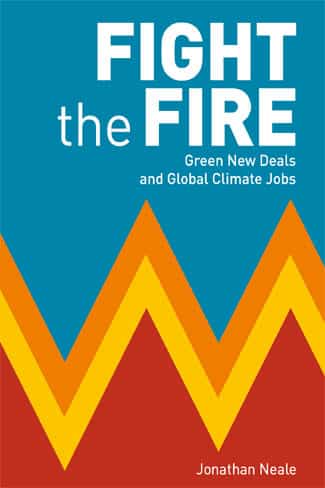
Jonathan Neale writes: I have spent the last year working on a book called Fight the Fire – Green New Deals and Global Climate Jobs. Most of it is about both the politics and the engineering of any possible transition that can avert catastrophic climate breakdown. One thing I had to think about long and hard was lithium and car batteries. [This article was first published by Climate and Capitalism on 11 Feb 2021.]
I often hear people say that we can’t cover the world with electric vehicles, because there simply is not enough lithium for batteries. In any case, they add, lithium production is toxic, and the only supplies are in the Global South. Moreover, so the story goes, there are not enough rare earth metals for wind turbines and all the other hardware we will need for renewable energy.
People often smile after they say those things, which is hard for me to understand, because it means eight billion people will go to hell. So I went and found out about lithium batteries and the uses of rare earth. What I found out is that the transition will be possible, but neither the politics nor the engineering is simple. This article explains why. I start by describing the situation simply, and then add in some of the complexity. Continue reading
Fight the Fire
Jonathan Neale’s new book Fight the Fire – Green New Deals and Global Climate Jobs can be downloaded as a free pdf or a free e-book here. It can be ordered as a paperback for £15 here .
Advance Praise for Fight the Fire
“This is a timely book. At a time when the world is still reeling from the ravages of Covid-19 and the massive economic dislocation that it engendered, now is the perfect time to reinvigorate the campaign for climate jobs, or, as in the case of the Philippines, to launch it. And this book is just what any climate jobs campaigner would need. It provides the big picture, the science and the politics of climate change, as well as the nuts and bolts of how such a campaign would look like. More than that, it is replete with lessons that the author has gained from a life spent fighting in the trenches of various campaigns.” – Josua Mata, Secretary-General, SENTRO union federation, Philippines. Continue reading
The Falmer Method – Towards a New Kind of Conference
Andrea Cornwall, Frank G. Karioris and Nancy Lindisfarne
With all the immense pressure on young scholars to present at conferences, to publish and find jobs, it is easy to forget that we got into academia because we were excited about thinking, reading and grappling with new ideas – and that academia is full of people who have those enthusiasms. In the early summer of 2014, at the University of Sussex in Falmer, we tried out a formula for a symposium which celebrated these values. The symposium wasn’t perfect, but it was pretty damn good, and we think the format will be of interest to others. We’ve decided to call it the Falmer Method.
Too many academic conferences bore senior scholars and scare young ones, sometimes quite badly. They are a way to test people, favour a few and put others down. And keep them down. Continue reading