A memoir of my mother by Jonathan Neale
This short book is 121 pages long. You can read it here on Anne Bonny Pirate, but it’s probably easier for you to download a PDF here.
Dedication: for Raymond.
The Mashpee Ambulance
It’s the summer of 2011. My brother Peter and I have a deal. He does the lawyer, the banks, the insurance and the nursing home. I tell Ma the bad stuff.
Neither of us can believe our luck. My job takes me about five minutes. Pete spends hours at Bank of America.
Ma and I sit side by side on the old couch on the eating porch of her house. I have my arm around her. She has grown very short.
“When Pete and I go at the end of August, you will have to go into a nursing home,” I say. I am careful not to use contractions, and to speak slowly.
“When?” Ma says. She’s stalling.
“At the end of August.”
“I can live here,” she says.
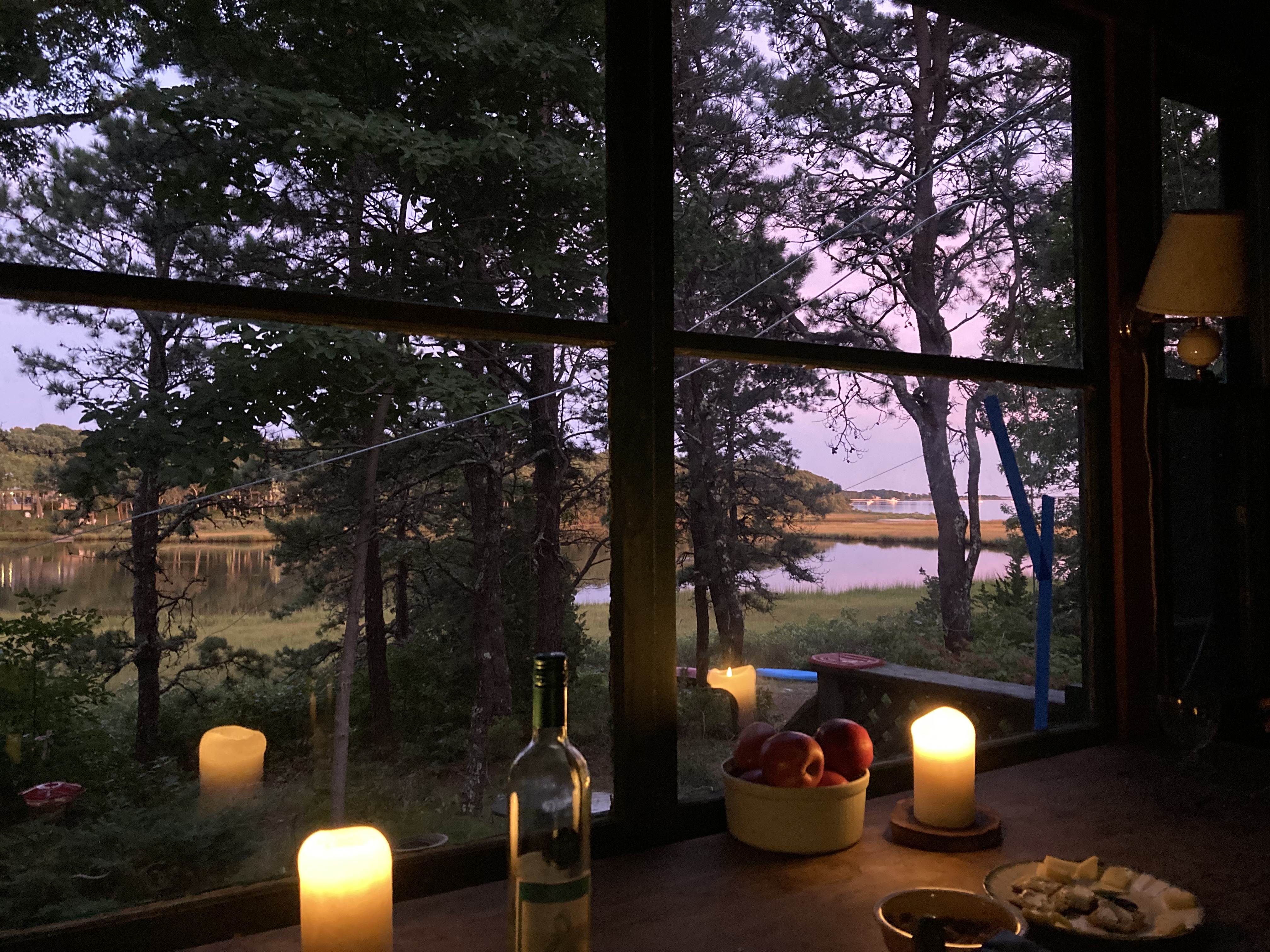
She lives in a wooden house on Cape Cod in Massachusetts, one story, sloped roofs. Her father had the house built in 1929, four years after Ma was born. From the eating porch we can see the squirrel hanging upside down on the bird feeder, and behind him the river leading into the bay.
Pete and I live in England. “I’m sorry. We have to go back to work,” I say. “You can’t live on your own.”
—
Later I tell Ma what I am worried about.
“I worry that if you go into the nursing home, you’ll cause trouble,” I say. I wouldn’t normally put it this brutally, but I want her to understand. “If you talk back, they will give you tranquillizers to control you. The tranquillizers will make you lose your memory. You will start screaming. And you will end up on a locked ward, still screaming. Covered in your own shit.”
I am nervous about saying “shit” to my mother. But I want her to hear this.
Ma looks at me. I know she wants to resist. She was in a nursing home for two months last year, after she had her stroke, or whatever she had. They weren’t sure. She hates nursing homes.
Ma smiles slyly. “They don’t call what I do making trouble,” she says. “They call it challenging behaviour.”
—
Pete wants me to get her to sign the “DNR” form – Do Not Resuscitate.
When I taught woodwork in a geriatric hospital in England, the doctors just wrote a big DNR on the forms. Here in America they need the patient’s permission.
“Why?” I ask Peter.
“The visiting nurse says we have to do it. If they give CPR to someone her age, they break all her ribs. If she survives, the pain is unbearable.”
I try to explain this to Ma.
She pretends not to understand.
—
I have a secret.
My secret is that I hope she dies before we have to put her into the nursing home. I tell people my secret. They say it’s OK, that would probably be best for her.
My bigger secret is I don’t want it because it would be best for her.
I tell Peter. He has the same big secret.
—
I go away for two weeks for a break with Nancy, my partner. Peter is alone with Ma in the house when the crunch comes.
I left home when I was 18, my dad left six months after that, and my sister six months after that. Peter was ten. Ma and Pete lived together alone for years. They loved each other fiercely. When things got tough at school, Peter used to go and sit in the kitchen. They didn’t have a dishwasher, so Peter sat in the hole where you’re supposed to put the dishwasher. Ma let him do that. They take care of each other.
Her breathing turns bad in the early afternoon. She’s gasping. Her stomach is bloating, pulling in, bloating out as she breathes.
Peter piles up cushions behind her back on the bed on the eating porch. From the bed she can see the pines and oaks down to the green of the marsh. She watches for the herons on the edge of the water and the swans in the river.
“I’m going to have to call the ambulance,” Peter tells her.
She has already told us always to call the ambulance from Mashpee, not the Falmouth one. We live on the border between the two Cape Cod towns. Mashpee is cheaper, and they often let the bill go.
“No,” Ma says. “No more hospitals. No doctors.”
This is it, Peter thinks. He goes into the kitchen, sits down at the small table and has a glass of Diet Coke and four sugar-free popsicles.
Pete goes back on the eating porch and sits down next to Ma. He speaks clearly and slowly. “I won’t call the ambulance if you don’t want me to,” he says. “But you have to know that then you could die.”
She looks stubborn.
Peter waits.
“You’re lying,” she says, and smiles.
Peter calls the Mashpee ambulance.
Falling
Ma is in Falmouth hospital for a week. Then they transfer her to a nursing home called Cape Care. That’s it. Pete and I don’t have to take her in when we leave. She’s already there.
I feel like shit.
On holiday with Nancy I tell her I can’t bear to leave Ma to die alone. Nancy says, “Go.” I go back to Massachusetts.
When Pete goes back to England, I stay on in her house by myself, and Nancy stays in England for the winter. I visit Ma in Cape Care every day at four pm. Some days I take her out and bring her back to our house, so she can sit on her porch in her own chair and look out over the river and drink a gin like a grown woman. Some days we stay on the ward and I read to her.
I have taken a year’s leave from part-time my teaching job, and my sister Kate in Australia gives me some money every month so I can live. She’s glad I’m staying. Every couple of months I go back to see Nancy briefly.
They put Ma on a regular ward, but she exhibited challenging behaviour. So they moved her to the Alzheimer’s ward. They said the staffing levels were higher and that ward would be better able to respond to her special needs.
Today I arrive and Ma is struggling with the seat belt on her wheelchair. “Help me,” she says.
I lean down and snap it open. It takes a lot of strength.
I wheel her down to the car. I stand in front of the chair and hold out my hands. Ma takes them in her hands and pulls herself up to stand. Then I turn gradually, with little steps, and she takes little steps too, like a dance, till we have moved around and she is ready to sit down on the passenger seat.
I get in the driver’s seat and reach across her to fasten the seat belt. This is always the moment when I will discover if her diaper smells. It does not.
“No,” she says. She doesn’t want me to fasten the seatbelt.
“I have to,” I say. “If I have an accident you will go right through the windshield.”
“So?” she says.
True. So, anyway my sister Kate says she lets Ma go without the seatbelt. Not worth the fight, Kate says.
We drive off.
“I don’t like it,” Ma says.
“That seatbelt thing on the wheelchair?”
“Yes.”
“I wouldn’t like it either,” I say.
There is a worse thing. At first they had Ma in the chair with a big slab of hard rubber fitted down into the wheelchair, across her front. It was too heavy and too wedged to move. It seemed to imprison her body. She spent hour after hour pushing at it, tugging at it, trying to move it.
There is an alarm on the back of the wheelchair that goes if she opens the seatbelt. I always have to remember to find it and turn it off before I get her out. That is so they can come running if she escapes herself.
There’s another alarm on the side of the wheelchair. This is connected to a thin stringy thing that ends in a roach clip. You attach the clip to her sweater or her blouse. If she moves out of the chair, she pulls that stringy thing loose from the alarm and the alarm goes off.
That’s the theory. But it doesn’t happen. She can’t get out because of the seat belt. When it does go off though, is when I undo the belt, and then help her out, and I forget to turn off this second alarm.
Actually I can’t turn it off. I could beat it death with a hammer. But there is no switch. What I have to do is find the stringy thing and reconnect it to the alarm and then it’s quiet.
When they put her to bed, they attach the stringy thing to her clothes and hang the alarm on the bars on the side of the bed. There are bars on both sides. They can be down or up. I can’t work out how to put them down. I’ve spent hours trying to figure it out Why don’t I ask?
Ma doesn’t want the bars up either. When they’re up, her hand reaches to me through the bars, and she looks up at me through the bars.
—
We go to the house, and then we return to Cape Care.
“Will you take me up?” she says. I am pushing her along in the front lobby.
“Yes,” I say.
“You won’t just leave me in the ward?”
“No.”
“You’ll come to the room and put me into bed. Not rush off?”
“Yes. Why do you always ask me this?”
“If they put me to bed, they use those things.”
“The bars?”
“Yes.”
For the first few months, she spent hours a day thinking about how much she hated the seatbelt and the alarms.
I unsnap the alarm from her clothing when I sit down to talk to er.
I’m supposed to snap it back on when I leave. I don’t.
Why? Falls.
Old people fall.
The first time I saw Ma fall was when we were living in Wales. She fell over backwards, knocking over the standing lamp. I ran to her as fast as you can across a small room.
I lean down – “Are you all right?” – meaning: Is it safe to lift you, or is something broken?
She is sitting on the floor, looking up at me. “Don’t tell anybody,” she says.
“Are you all right?”
“Promise me you won’t tell anybody.”
“I promise.” I am still holding out my hands. She takes them and I pull her up.
She brushes the sides of her trousers, literally brushing herself down. “I’m sorry to be like that,” she says. “But they make such a fuss if you fall. They think all old people fall.”
—
Months later I tell Ceci back at Nancy’s house in Oxford about the fall. “Yes,” she says. “She fell here too, when it was just me and her in the house. She made me promise not to tell anyone.”
“And you didn’t,” I say. “Good.”
“Now I’ve told you,” she says.
“And I told you,” I say. “Not so good.”
“It seemed really important to her,” Ceci says.
Back in London I got out a DVD of a film with Peter O’Toole as an old actor on the edge of dying, but still letching away with a young woman.
“We could watch this,” I say to Ma. “But you probably won’t like it, because it has sex in it.”
“Don’t censor what your mother watches,” Nancy says to me.
“I want to watch it,” Ma says.
We settle down to watch it. There is lechery. I like the movie. Peter O’Toole dies at the end.
“What do you think?” I ask Ma.
“He fell,” Ma says. Her eyes are shining. “That was just what it’s like.”
“I cried at the end,” I said.
“The way they showed it,” Ma says. “The world suddenly goes all fuzzy and you just fall straight down. That’s how it is.”
“I’ve never seen that in a movie before,” she says. “It’s frightening when it happens, but it’s much more frightening for other people. But the movie showed those people how it is.”
After I get back from the home, I have dinner with my cousin Win and his wife Pia. We sit at their table. There is always good food, and always small portions, though I am encouraged to take seconds.
Win is ten years younger than Ma, has known her all his life. He visits Ma every Wednesday after his church men’s breakfast and reads to her. That makes Wednesday my day off, when I don’t go in. Win has just finished reading her Kim and they’ve started on the Lord of the Rings.
Pia holds out her hand, reminding me about grace. I hold my other hand out to Win. This used to make me nervous, Englishman that I am, afraid of God. Luckily Pia does not mention Him directly. I shut my eyes.
“Thank you for this food,” Pia says, “and for the time to be together. And thank you for bringing Jonathan here, to make Bobby’s life easier.”
Bobby is Ma’s name.
I open my eyes, we drop hands, and I start on the cheese pie. Yum. Pia asks how Bobby is.
I start ranting about falls. “All they care about is falling. They tie them down. They strap them in. They barricade the beds. So they’re prisoners. And they hate it. You can tell. When they first come in, they spend day after day after day picking at the alarms, trying to undo the belts. It’s like a prison, is how Ma put it.”
“Falls are serious,” Pia says.
“They don’t care about anything else.” My rage surprises me. “If you listen to the people calling for help from their wheelchairs, they’re all calling for help going to the toilet. So they don’t shit in their pants.”
Win and Pia don’t talk like that, but I’m angry. “That’s what they want. It’s all about falling and insurance.”
“I understand,” Win says.
“But it takes months for bones to heal at that age if they fall,” Pia says. “It happened to my sister and it was terrible.”
Pia’s sister died while on a visit here two years ago. Pia mentions her at least once every time I visit them. I think she must mention her sister every day. When Pia came from Germany to live with Win in the 1950s, she was leaving her family, and would not see them for years. They were very close. They had gone through the war together, and the two years after the war when two million Germans died of hunger and disease.
“Half the old people who fracture their pelvis are dead within a year,” Win says.
—
Two years ago, Ma stayed at an independent living facility over the winter. The place looked nice, and she had her own apartment, with a living room/kitchen, a bedroom and a bathroom. She had to make her own meals. The first week she was there she put her supper in the microwave with a fork on the plate.
This could happen to anybody. It has happened to me, for instance.
When I did it, there was a lightning bolt inside the microwave. It was really exciting. When Ma did it, she set fire to the microwave. The staff came running in and got her out of the room.
So they made a rule. She could not cook in the room.
She made cheese sandwiches instead.
One night she left her room. Maybe she had a nightmare. Maybe she needed help. Maybe she was not sure where she was. Maybe she fell. Or maybe she lay down because she was tired.
Whatever it was, two night staff found her lying outside her room. They couldn’t pick her up because the insurance did not cover it. Who knows what could happen to Ma if they picked her up.
So they woke her up. She couldn’t get up off the floor. They called the ambulance which took her to Falmouth hospital. They told the ambulance maybe she had had a small stroke. Maybe she had. Or maybe they called an ambulance because they were forbidden to help an old lady back to her room, and when they paramedics came, they were so embarrassed they said she had a stroke.
The hospital never did decide if she’d had a stroke. Or not.
—
In November I move into my neighbour Betsy’s house for the winter. Betsy has gone down to Philadelphia until spring. She is not charging me rent. Her house is insulated, and heated. Not like mine. So I have a place to take Ma back to safely.
Betsy is a good person.
I drive Ma back to Betsy’s one afternoon in December.
Another good thing is it’s easier for Ma to get from the car to Betsy’s house than from the car to our house. Our house has the long path with paving stones. At Betsy’s I can park six feet from the back door. Ma can get out of the car, stand up, take a few steps, and grab the rail that runs next to the back step. On that she can haul herself up and into the house. Then it’s through the door, leaning on me, turn left, and shuffle about four feet till she can sit down on a couch and rest. The couch is on the porch, and it is not as well heated as the rest of the house. Sometimes Ma gets up after a minute or two and walks into the living room. Sometimes she rests on the couch for twenty minutes, and I tuck a warm quilt over her. Often she sleeps.
This time I park the car, undo her seat belt, get out and walk over to her side. I reach down, hold out my hands, and she takes them and stands. Then I sort of pivot sideways with little fairy dance steps, so I am not blocking Ma’s way.
I feel her legs failing, hear her say, “OH”.
“Just a little bit.” I speak quickly. “Just a few steps.”
“No,” she says, meaning not refusal, but I can’t, and meaning do something.
I can feel her leaning away from me. Hard to pull her weight back.
“No,” she says louder, meaning I’m frightened you’ll pull my arms out of the sockets, frightened you’ll hurt my back, I’m angry that this is happening. “Do something,” she says.
“I can’t.” I can feel her going. Fast, inexorable, but it feels slow. I keep hold of both hands and manage to lower her to the ground, so she doesn’t bump.
She’s sitting on the ground and I’m standing over her. I lean down and offer her a pull up.
She just looks at me.
She can’t do it, of course. Her legs went.
I sit down next to her. The grass is long, and thick and soft to sit on, but wet.
How to handle this?
“Well, here we are,” I say.
“Yes.” A little laugh. She looks around her.
“I love the view of the bay from here,” I say.
So we look out across the bay. The water is blue grey in the winter light.
“You know that poem about the Bay by Aunt Net?” I say.
“No.”
“The one she wrote in 1950. Where she says she’s travelled all over the world, and still she thinks the view over the Bay is the most beautiful in the world. Even though she knows it isn’t. But that’s how she feels.”
“I don’t know it,” she says.
“That’s how I feel,” I say.
“Me too,” Ma says.
We sit on the long grass and look out over the bay.
“Can you read it to me sometime?” Ma says.
“I can’t find it. I’ve been looking all over the house for it.”
“When you find it,” she says.
In a little while I stand and hold out my hands. She takes them and stands. We go into Betsy’s warm house.
Books
I took my daughter Siobhan to Cape Cod for the first time when she was eight. We sailed up to Sedgelocks and anchored the boat in shallow water. We walked across the dunes, Siobhan and I hopping and screaming as the bright white sand burned the soles of our feet. Ma wore shoes. The three of us stood and looked across the Sound towards the Vineyard, low in the distance.
“This is Dad’s favourite place,” Siobhan told Ma.
“Sedgelocks?” Ma said.
“The Bay,” Siobhan said. “Everyone has a special place. This is Dad’s. You can see he’s calmer here.”
“Look at him,” she said to Ma.
I was a happy child until I was ten. I was happy here until I was eighteen.
In early March I move back into Ma’s house.
My grandfather built the house. We always called him the Captain. He loved to work with wood. His house in New York was an old brownstone on East 95th Street, the Upper East Side. The Captain’s day job was as a doctor on Park Avenue, specialising in diseases of the rich. In the evenings the Captain and I disappeared down into his cellar, and I worked with him on whatever he was making. It was dark down there, with the light of a lamp focussed on the work bench. It smelled of oil and new cut wood. The Captain loved having children by him as he worked.
On the back of the living room door is a photograph of my mother at thirteen. Everyone recognises it with a smile or a little laugh. “That’s Bobby,” they say. She is wearing shorts and looks surly. She sits with her legs up on the gunwale, the long seat along the side of the cockpit of a boat. She has a book in her hands and is looking up at the camera.
Now Ma is lying on the couch in the living room. I bring the picture over to her.
“I love that,” she says. After all, she hung the picture on the wall.
“You look surly,” I say.
“Yes,” she says. “Boats.”
“I never met anyone who got away with reading on a small boat,” I say.
“Wasn’t easy,” Ma says.
“And yet you were the only person I know who wasn’t worried when I sailed the Atlantic,” I say. “I was surprised, given how much you worry about everything else.”
“Our family all know how to sail. Why worry?” she says.
“I thought your parents were always trying to get you up and doing things,” I say.
“That’s why I liked Carol’s house,” she says. This Carol was her cousin, Aunt Marg’s daughter. Ma and Carol were the same age, and best friend all their lives. Carol’s father was the older brother of Ma’s mother. He was a career diplomat – first secretary at the embassy in Nicaragua in the early 1930s, later ambassador to Haiti under Duvalier and Santo Domingo under Somaza. Dana had been a pilot in World War One, and in Nicaragua he pioneered the use of aerial bombardment against the guerilla uprising led by Sandino. Uncle Dana was one of the nicest men I’ve ever met. In the family he had a reputation for gentle wisdom. He loved messing about in small boats too.
“I could just go over to Carol’s house and sit on a couch and read all day,” Ma says. “They approved of books.”
“When I married Sally,” I said, “we went up to visit her parents in Edinburgh.” I was twenty-five then. My mother approved of Sally. Her parents were both academics. He was a professor of biology and she was a professor of history. “Sally’s mother and father each had a special chair by the fire,” I tell Ma. “And on the floor by each chair was a pile of the books that person was reading. I looked at those piles and thought that will be my life, going for walks on windy days with my children and then sitting together reading.”
“Piles of books?” Ma says, her face wistful.
“Yes.”
“That’s so nice,” she says.
Spaghetti
I sailed with the Captain in his boat Seacrest, an old wooden ketch, thirty-eight feet long. When the Captain started sailing, he went down to the old sailors’ mission in New York. He told them he would hold a clinic one afternoon a week if the old men would teach him knots in return. Some of those men had worked on old square riggers. They taught him every knot, even the impossibly ornate Turks Head. It was literally old school. The Captain loved it.
Kate and I flew up Newfoundland to join him on the Seacrest. We sailed down to Nova Scotia, just the three of us. I was thirteen, Kate was twelve, and the Captain was sixty-five.
In the late afternoon of the first day of our ocean passage from Newfoundland to Nova Scotia, I was on watch, my hands on the wheel, a woolly hat on my head. White caps speckled the grey green water. My eyes moved from the mainsail to the water to the bow, flicking back and forth. I was cold and happy. The sun was almost down.
The Captain’s head popped up from the hatch to the galley. He wiped his hands on a rag. “I just put a can of Spaghetti-Os in the gas tank,” he said. Spaghetti-Os were small finely chopped bits of canned spaghetti in a thick lumpy red sauce. “The Spaghetti-Os will work their way all through the engine and clog it up. There’ll be no way anyone can fix it.” The Captain beamed at me with satisfaction. “My wife made me put in an engine. She worries I’ll have a heart attack alone out here.”
We smiled together.
“They didn’t have engines in the old days,” the Captain said. He looked around at the water and the sky. “Looks like a nice night. Want some bacon?”
As we sat in the cockpit and ate, he told me about learning to sail. “When I first got married, I didn’t know anything about sailing. I was just a hick from Missouri. Her family were all New England, if you know what I mean. We only talk to the Lodges, the Lodges talk only to the Cabots, and the Cabots talk only to God.”
I remember my great-grandmother sitting in her rocking chair on the porch in her old age, looking out over the Bay. She was hard New England, back straight, white shawl, mouth grim and silent. Her children knew she was bored and wanted to get her one of the new television sets. She resisted, but they brought a television over one afternoon to show her and tempt her. The only thing they could find on was midget wrestling. “Get that thing out of my house,” Great-grandmother said, and they never tried again.
I told the Captain about the midget wrestling and he laughed.
“You know how the relatives are always looking when you come in from sailing,” he said, “to see if you pick up your mooring first time? You can’t see them for the trees, but you know someone’s watching, and if you miss the mooring, by the time you go over for drinks, everyone knows.”
“Yes,” I said.
“Well, I got myself a boat. With a motor. And in the summer mornings I used to get up before dawn and crawl out on the roof. Our bedroom was on the second floor. I’d drop to the ground, and row out to the boat, and take her out into the Sound under motor before anyone was up. Then I’d turn the motor off in the middle of the Sound, and raise the sails, and make my mistakes with no one watching. When I was finished, I’d lower the sails and motor back in.”
He won a medal from the New York Yacht Club in the end, for cruises under sail in Labrador among the icebergs, trying every year to get far enough north to turn into Hudson’s Bay. The citation mentioned that most years he and all his crew were over sixty.
—
Years later I wrote a novel about two kids, a boy of twelve and his sister of eleven. They set out across the Atlantic on a small sailboat. It belongs to their mother’s new boyfriend, who pours a can of Spaghetti-Os in the engine, so they have to rely on the sail.
Nancy told me to take that bit out, no one would ever do that with children on board. My agent, Laura, told me to take it out. Couldn’t happen, Laura said. The editor, bless her, told me to take it out. The copy editor said she hoped I didn’t mind her saying, but there was one thing I ought to take out because it just wasn’t possible.
The reviews were good, but one of them mentioned that the only thing that marred the book was a totally unrealistic bit about a can of spaghetti.
My sister Kate read the book and said her favourite part was the Spaghetti-Os.
When I got home from sailing with the Captain I told Ma about the Spaghetti-Os. She forbade me or my sister ever to go sailing with the Captain again. Now I’m sure she’d been waiting a long time for a reason to get me away from him.
Our Book
This book is Ma’s idea. She’s been talking about what she could write.
“Do you think I could still write a book?” she asks.
“No,” I say.
She talks about what kind of book I could write. And then she has it: we can write a book together. She will listen, and report to me, and I will write it down. So people will know what it is like in care homes.
“Lots of people end up like this,” she says.
I ask her questions and she reports.
She told the two women who were putting on her clothes in the morning that I was writing a book about the home.
“They looked shocked,” she tells me happily. “Worried.” And then they thought about it and told her, “That would be a very interesting book.”
—
Ma hates the two people who wake her up and dress her. She hates being made to get out of bed. When we were kids, we had to tiptoe around in the morning because she hated getting out of bed. When she left home, her father the doctor told her she should get her thyroid checked. Typical of him, she thought, criticising me for not working hard enough. She got it checked in her 50s, when she almost died of low thyroid.
But she still doesn’t like to get out of bed.
“They tell me to shut up,” she says. “They say I have children who visit me every day, and lots of other relatives and phone calls. So I should stop complaining.”
The first time Ma was in a rehab home after a hospital stay, Kate came from Australia and I came from England and we got her out and home in a week.
We had to meet with the social worker from the rehab place, me and Kate at her round a table in a small conference room. I thought the social worker was going to talk to us to suss out if we could support Ma properly. No. She just wanted to fill out long forms and have us sign them. She was withdrawn, a stone-faced uncaring German woman.
I signed the last form and said, “Is that it?”
“Yes,” she said, and began to cry.
Kate and I sat there as she cried, not knowing what to do.
She pulled out a hankie. “I’m sorry,” she said. “I see all these people, and none of their children come. And your mother has two children who’ve come.” She cried some more.
Once we got Ma home, the visiting nurse came and checked out Ma was all right. Nice woman, good at her job, she worked swiftly in a way that seemed unhurried. About 40. Afterwards Kate walked the visiting nurse out to her car. I looked out the screen door and saw them standing by her car, the woman crying.
When Kate came back in, I asked why the woman was crying.
“She said all the people she sees have no one, and Ma has both of us.”
I explain to Ma about how you need to have characters in nonfiction books, just like in novels. Who could our main characters be, I ask.
“A member of management could just float by from time to time,” she says.
“What would they be doing?”
“Holding someone’s hand,” she says.
I watch that day. I see Rebecca, the manager, as she moves up and down the corridor, holding the hand of someone in a wheelchair, chatting to them as she helps to pull them along.
I am worried about the book now. How do I put in all the things I want to say? Ma thinks it will be a book about a care home. For me it is becoming a book about me and her. She can’t possibly read it. I can’t read aloud to her what I think.
We get her from the chair into the car in the parking lot. As she sits down in the passenger seat I lean across her, like always, to fasten the seat belt.
“I have been thinking about the book,” she says. “I don’t want to embarrass people.”
“I’ve been worrying about that too.”
“I don’t want to hurt anyone,” she says.
“Or be ashamed yourself.”
“That too.”
“I’ve been thinking about it. I can make it a novel. Just tell everyone it’s a novel. Then we won’t have to be ashamed.”
“I don’t know,” she says, because of course that won’t solve the problem.
I have always avoided writing stuff that is too personal. I write about other people. It’s a weakness in my writing.
Kurt Vonnegut was teaching a creative writing workshop at the University of Iowa in the 1960s. Halfway through the class he lost it because his students were holding back. “OK,” he said. “This class stops now and you all go home. Come back when your parents are dead.”
Vonnegut got round this by writing science fiction.
Luckily for me, my mother will be dead soon.
Dickie’s Boat
Ma’s house on the Cape is ninety years old. There is no basement, and no foundations. It sits on concrete breeze blocks. At the shore side of the house there is about four feet between the earth and the floor. At the upper side of the house there is about a foot. Cross hatched wooden slats conceal the mess under the house. Some of the slats are gone, and in many places the dark green paint has peeled off. I have to do something about that. Next year, maybe.
In the winter we store boats under the house. Nancy has come to visit, and she’s thinking about buying a kayak. You can get small ones for four hundred dollars from West Marine in Falmouth. It’s a marine superstore that has replaced the scattered boatyards of my childhood.
“There are two old wooden boats under the house,” Nancy says.
“Where?”
“Just by the outside shower.”
We go and look. Jesus. Who knew? Rotten and falling apart.
I take Nancy down to the marsh below the house, beyond the marker for Grandma’s ashes, and show her the old wooden boats with flowers growing in them. “That’s my first rowboat,” I say. “I painted it blue grey and called it the Revenge, after Sir Richard Grenville’s ship.”
“Who?”
“In Tennyson’s poem. Grenville was mortally wounded. His men laid him on the quarterdeck.”
I put on my poetry voice:
“Then up spake Sir Richard,
Sink me the ship, master gunner,
Sink her, split her in twain.
And the gunner said aye-aye,
But the seamen made reply
We have children, we have wives
And the lord has spared our lives.”
“Oh,” Nancy says.
“And that’s Dickie’s boat,” I say.
Ma has a picture of Dickie sailing his dinghy hanging on the wall of her bedroom.
—
Ma and I are sitting at the table on the eating porch. She is in her favourite chair at the head of the table. “How quickly did Dickie die?” I ask.
“It was rheumatic fever,” she says. “We didn’t have any antibiotics then.
“How old were you?”
“I was ten. He was six. He was such a beautiful boy. He just got sick and the next day he was dead. It was very fast.”
“After Dad died,” she says, “Mother told me she kept urging him to take Dickie to the hospital.”
“You were in New York?” I say.
“And he kept telling her no, they didn’t need to. When they got to the hospital the doctors told her it was too late. She thought Dad had refused to take Dickie to the hospital because he was afraid the other doctors would think he was making a fuss.”
“Mother said she never forgave him for that,” Ma said.
They were married for another fifty years, I think. Man and wife.
“Did you know this then?” I ask.
“No,” Ma said. “They just came home and told us Dickie was dead.”
“Didn’t you sense anything?”
“I was a child. When you’re a child, all you have is what you’re told.”
There is another version of what happened. My sister has read the journal Aunt Marg kept the year Dickie died. Aunt Marg was my grandmother Carol’s sister-in-law.
In Aunt Marg’s version it took three weeks from when Dickie got sick until he died. And for the first two weeks the Captain did not admit any of what was going on and got the diagnosis of rubella wrong. Then he put Dickie in the hospital. Once he put Dickie in their Captain would not visit his son. Aunt Marg said he could not bear to look at Dickie, because he had handled the case wrong.
The Captain also forbade his wife Carol to visit Dickie in hospital. She obeyed him. He said it would not be good for her to see the boy suffering.
After a week Carol couldn’t stand it any longer and went into his Dickies’ room. He cried and said, “Why didn’t you come, why didn’t you come?” She was able to hold him for a few hours before he died.
My sister Kate finishes telling me that.
I drink my bourbon.
“I didn’t tell Ma what I read in Aunt Marg’s diary,” Kate says. “She couldn’t have dealt with that.”
No one ever tells my mother the truth, I think.
How the fuck could everyone decide it was good for her not to know the truth?
I don’t tell her either.
A Sad Book
She’s asleep when I arrive at Cape Care. If I am very still, I can have some quiet time reading.
Half an hour later she wakes up. There is that smile of gentle joy on seeing me. I like that.
“What are you reading?” she asks.
“A book by a woman named Katherine Boo. It’s about people in a slum in Bombay. I thought maybe I could read it to you.”
I thought this because we lived in India for three years when I was a child. The third time, in Lucknow, we had two servants, a cook and a sweeper. Ma spent a lot of time talking to Kumti, the sweeper. Kumti was often late for work, or shattered, because she had been up all night dancing. She was what is now called a Dalit. They’re the people at the bottom of the caste system. There are some advantages to being at the bottom. One of them is you are allowed to dance all night.
Just before we left Lucknow, Kumti was diagnosed with tuberculosis. I had a test for TB, and it came back positive. But Westerners, in good health, just have a case of TB they don’t even notice. I assume Kumti eventually died of it.
“But,” I told Ma, “the book’s too sad. It’s the saddest book I’ve ever read. You keep thinking things can’t get worse, and then they do.”
“You shouldn’t read sad books,” she says. This is bedrock for her.
“It’s just such a good book.”
“Don’t go looking for sadness,” she says. “Sadness will come to you.”
She curls up on the bed and wraps her arms around herself.
Cockneys
The way my mother speaks in this book is not really the way she speaks.
If I wrote the way she speaks now, she would sound like an idiot.
In reality she says, “The man,” and stops.
“What man?” I say.
“Man,” she says.
“What man? Jeff Livingstone? Tony? Win?”
“That one,” she says.
“Winthrop?”
She nods.
“Winthrop came in yesterday to read to you.”
“No.” Shakes head.
“You don’t remember him coming.”
No. She doesn’t.
“He told me he did. I saw him this morning. He said you were very sleepy though.”
In this book the conversation is:
“Winthrop didn’t come in yesterday,” Ma says.
There’s a reason for this. She’s still thinking. Her brain is working. The way I know is how she laughs to herself when I tell a joke. Most of my jokes are contextual, not one liners. So you have to hear them and know why they are funny in a particular context.
And she does.
So pidgin human won’t capture who she is.
Part of the problem is that she doesn’t have much lung power now. She gets tired halfway through a sentence and stops.
Another problem is that she knows what she wants to say but.
“Is it that you know what you want to say, but can’t find the words?” I ask. “Or is it that you have the words and can’t say them.”
“No,” she says.
We go round the houses. It turns out what she is trying to tell me is that she knows what she wants to say, but she doesn’t know how to put it into words. That’s not just a matter of searching to remember the right word. It’s not just how to say it. It’s how to think it.
I tell her I know what she means, and I don’t know what the word for that is. She laughs.
—
There’s a similar problem in all writing. Lots of people write the Cockney characters in English novels as if they speak funny: “It weren’t ‘arf ‘ot mum.” It’s true. They do speak funny. But then they write the upper class characters as if they pronounce English spelling and don’t sound funny.
Many American writers used to do the same with slaves and now do it with the ‘hood.
So one group seems normal, and the other seems stupid.
I tell all my creative writing students, never write a character who is stupider than you. Always make them at least as smart as you. One reason is that smart people are more interesting. Another reason is that poor people have brains. The deep reason is that if you set out to write someone stupid, you distance yourself from them, and then you can’t write from inside them.
So my mother speaks in sentences here, the way she always used to.
Her sentences are grammatically correct. She was an English teacher.
Going Steady
Ma grew up two doors down from my father in New York City. Kate and Pete and I called our father Terry.
The back yards of all the brownstones on the block in New York were all linked by paths and gates, and the kids played in a gang together. When Terry was nine Bobby invited him up to Cape Cod for the first time. After two days Terry had to call up his mother and ask her to come get him and take him away from this dreadful place. But Ma and Terry remained close friends.
Terry never forgave Ma’s big brother Bill for bullying him in the backyards in New York. Bill was a stocky boy, three years older, and he hit Terry a lot.
When they were seventeen Terry asked Bobby to go steady with him.
She said no. It sounded vulgar.
How about getting engaged, he said.
They went and told their parents they were engaged, first her parents and then his. Both sets of parents laughed at them.
Once they were engaged, they could have sex.
When they were nineteen Terry was in the Navy and about to ship off to fight in the Pacific. So they could get married, and what could their parents say?
Ma looks radiant in her bridal dress. It’s the one photograph where she looks beautiful.
Ma has never liked cameras. The family decided that her little sister Cynthia was the beautiful one. Ma was the plain one. This was a disappointment to Ma’s mother, my grandmother, who had been a beautiful young woman.
Sidney comes to visit at the Cape. He is a couple of years older than Ma. He still moves gracefully, his body long and gangly. Sid taught Russian literature for many years. I ask Sid who his favourite poets are.
“In my youth it was Blake and Yeats,” Sid says. “And over the years I wandered a lot. But now I’m back with Blake and Yeats.”
Sid has mobility, and all his brains. And he smiles a lot. I envy him on Ma’s behalf. He talks to me about my father, one of Sid’s best friends. They met in a maths class at college.
“Terry asked me to be the best man at his wedding,” Sid says. “He said he had to ask me, because all his other friends were Jewish. And I said, but Terry, I’m Jewish too.” Sid laughs at the idea of a man brought up in New York at that time who couldn’t even tell if another New York boy was Jewish.
Sid says, “And Terry asked, what do I do? And I said, I’ll do it anyway. And I met Carol at the wedding.”
The Carol who was Ma’s cousin, and her best friend. Sid married her.
We talk about the Captain’s boat, the Seacrest. “I was going to go sailing on the Seacrest once,” Sid says. “I drove up to Nova Scotia with Bill and the woman he was seeing then. Nice woman, I think her name was Jill. When we got there the Captain took Bill aside and told him he had no business bringing that woman along when he was still married.”
“Bit much considering what the Captain used to do,” I say. I know he was a womaniser. I’m checking if Sid knows.
“Didn’t matter,” Sid says. He does know. “The point was you didn’t bring it home to family. The Captain took Bill off to one side, and was lecturing him, hard, and Bill was just looking at the ground. Then we got in the car and drove back down to Boston. Two days. That was the worst trip of my life. Jill didn’t talk all the way. The humiliation. Bill drove. That was the end of their relationship.”
“Bill was thirty years old,” I say.
“I don’t think Bill had a chance after that,” Sid says. “It’s the only time I’ve seen a man destroyed in a few minutes.”
Communists
Ma was on the left. In college at Barnard in New York most of her friends were Jews. She collected money for the CIO and joined the American Friends of the Soviet Union during the war. Her sister Cynthia refers to it as the period when Ma “checked hats for the Communist Party.”
In my early childhood Terry and Ma had one very bad fight. We lived outside New Haven in Connecticut. Ma was running for the school board on the Democratic ticket. It was the fifties. The Republicans were in control of the school board – it was the suburbs. During the campaign the Democrats found out that one of the teachers in the junior high school had once been a Communist. They attacked the Republicans for harbouring him. He lost his job.
Ma wanted to pull out of the race, there and then. It was so wrong. Terry said no, she had to stay in until the election. He was afraid of what would happen to his job if she became a cause celebre. So she stayed in the race.
We had a babysitter when Terry and Ma went out to talk about this. When they came back they didn’t say anything, but the room rippled with their pain.
The morning after the election I read the paper secretly to see if Ma had won. She came last of four candidates. I was surprised.
Ma was not in any party after that. She’s always been a Democrat, though there are years she can’t bring herself to vote for the Democrat.
We are sitting in the living room, home from Cape Care Home for the afternoon. It is always dark in here. Ma apologises to me for making me so left wing.
“How?” I say.
“When you were a baby,” she says. “It wasn’t safe to say the things I thought to anybody. So I said them to you. You would play in your crib, and I would tell you how the world was unfair, and it wasn’t right what was happening, and working people should have unions. And how you should always fight for what you believed in. And I didn’t think you could understand me, because you were so small. But then when you grew up, I knew you had been listening. And I had indoctrinated you.”
“I don’t remember that,” I say.
“Your life would have been so much easier,” Ma says.
“I don’t regret it,” I say.
“I’m sorry,” she says.
Dancing Girls
I go in early today, get there by 11.30. I figure if I do that maybe Ma will be awake. And it works. We talk for two hours. Mainly I talk.
“Talk about something,” she says.
“What?”
“Anything.”
“I’ve been thinking about when I was a kid,” I say.
I’ve been thinking about this. If she can’t talk much anymore, I can make conversation by saying things. I’ll talk about how things used to be.
“What I remember about Texas is lying on my back looking up at the clouds. The sky is deep blue in winter, and the clouds are white and move fast because of the wind. And you can lie there and look up at them for two hours.”
She is not so interested. I’ll change the subject.
“I remember Shimla, when I was 12,” I say. Shimla was a hill town near where we lived in Punjab. “It was just ten years after the British Raj. You remember all the old colonial hotels?”
She nods and smiles.
“The dining rooms cavernous and dark and empty,” I say, “the waiters in uniform with green turbans standing along the walls with nothing to do because the English had left.”
“But what I really remember about Shimla,” I say, “is walking along this path, maintained, like a British path, zigzagging back and forth up the hill. And I came round the corner, and there in front of me was the whole Himalaya in the distance, two hundred miles long, from Annapurna to Kanchenjunga. I had never seen even one Himalaya before.”
She asks, I think, if she was there too.
“I can’t remember. In my memory it’s just me and the mountains. Doesn’t mean you weren’t there.”
“All the mountains,” she says and smiles, an interior remembering smile.
“When I was 12 we went to Fatehpur Sikri too,” I say.
She doesn’t remember.
“Fatehpur Sikri was the old Mughal capital, near Agra. It’s in ruins now. What I remember about that is they had this little stadium with a giant chess board. Each of the squares of the chessboard was a great flat slab of colored marble, three feet by three feet. In the old days a dancing girl stood on each of those stones. Some of the girls were dressed as pawns, some as knights, some as the other pieces. Two lords would sit on the seats above the chess board, playing. They would study the girls and the board, and then order one of the pieces to move. And that girl would dance from where she stood to her new place. Dance two squares forward and one left if she was a knight, all the way along the diagonal if she was a bishop.”
Ma nods, smiles, to tell me she still knows how chess pieces move.
“Where is it?” she says.
“Fatehpur Sikri, the old Mughal capital. You remember we went there.”
She shakes her head.
When I was 12, the idea of being a powerful man who made dancing girls into my pawns was overwhelming. It remains my top fantasy. The production values are really big though, and I have been unable to make it real yet.
Ma is smiling at the idea of dancing girls on the chess board. But she seems to think they are there in India now.
“I remember the hurricanes when I was a kid,” I say. “In 1954 and 1956, I think, so I would have been 6 and 8.”
“Where?” she says.
“On the Cape,” I say. “In our house. I remember Carol was there.” My mother’s cousin and best friend comes into many conversations with Ma. “So her children must have been there too. And the wind was howling outside, and we were jumping up and down on the sofas in the living room and on the eating porch. But the grownups were so scared they weren’t having any fun.”
She smiles, nods, remembers the fear, but it’s a joyful memory now.
“And I remember your first cat, Sally Figaro,” I say.
“Everyone knows her,” Ma says.
“She was a calico, wasn’t she? One of those ones that’s lots of colors?”
“She had a lot of colors,” Ma says.
“I remember her sitting on the kitchen floor, looking, concentrating on your back, waiting for you to feed her. And I remember her on the back step waiting to be let in.”
Ma loved Sally the best of all the dogs and cats. I don’t know why. It felt like she and Sally Figaro had been through a lot together. They were both mothers. Maybe that was it.
“Being a domestic cat is the best thing there is,” I say. “You can be a pet for as long as you want, lying around indoors, warm and fed. And then when you’re bored you go right out the door and become a wild animal. Go as far as you want, if you can, fight, explore, hunt. And when you get cold and hungry, you walk right back into the house and become a pet again.”
She likes that too.
“Dancing girls,” she says in wonder.
“But they don’t have them anymore,” I say. “That was four hundred years ago. It’s ruins now, like a castle.”
“But the best animal of all is a dog in a Buddhist monastery,” I say. “I was hiking in Zanskar, in the Tibetan Buddhist part of Kashmir, and I found this monastery up in the mountains. Old style, every family sent the second son to the monastery. So there were one hundred monks, and two dogs. And one of the things the monks had to do was show compassion to all living things. But the only living things they had were the two dogs. So they lined up to pet the dogs.”
“The dogs lined up,” she says, and smiles at the idea of dogs lining up to be petted.
“No, the monks lined up to pet the dogs. Because they only had two dogs, and lots of monks who had to show compassion. So the dogs just sat there in the sun and one monk after another petted them.”
She’s got it.
“Are you writing all this down?” she asks.
Where did that come from? Then it dawns on me. She’s proud of me, for having good stories. My mother thinks my conversation is good enough to go in a book.
“Yes,” I say.
Texas
At first Texas was hard for her. She was furious with Terry for not getting tenure at Yale. It meant he could only get a job at the University of Texas, and we had to go to Austin. I was ten.
I didn’t know she was furious. I just knew it was the worst journey of my life. Seemed to go on for ten days, driving across the new interstate system. I loved motels. I loved raspberry sherbet at Howard Johnsons. Pete was three. He stood in the well in the back, behind the back seat, interested in everything. Lassie, the dog, long haired and hot, panted at my feet in the back seat. Kate and I had impetigo, which gives you running sores on your legs and arms. We wrapped wet towels around the sores and itched and tried to be good. In the front our parents fought about directions.
Terry was also furious and turned inwards.
He had bought us a house, out in the country, fifteen miles from Austin, without consulting Ma. The nearest house was on a hill, a mile away. Our place had been a goat ranch, with two thousand acres. We just bought the ranch house, ten acres, two ponds, a couple of outbuildings, some pens for the goats, a well and a pump. The two thousand acres belonged to a congressman up in Washington, who ran old cow roping ponies on it.
My mother was appalled. This was not New England. She was alone.
The neighbor lady came round with a casserole, and a lot of useful advice. She was kind. Her husband was a goat rancher too, a man in a black hat and boots, good with children. They ran angora goats, from near Ankara in Turkey. Angora sweaters, soft and expensive, are made from their wool. The land was too arid for cattle or sheep, but goats can live almost anywhere.
The neighbor told Ma that for nights when Terry went away, she would need a rifle. Also, she should keep a handgun in the kitchen drawer nearest the front door, so you could get them fast as they came through the door.
Ma and Terry took me to Sears Roebuck in town and bought me a .22. I felt so grown up. I went out and lay on my stomach like a sniper above the pond – we called it a “tank” in Texas. I fired bullets into the middle of the pond. Then I tried to put the next bullets exactly in the middle of the expanding ripples.
I didn’t want to kill anything. Sometimes I went for walks by myself for hours and shot holes in the No Hunting signs like everybody else. B33ut I came to understand that the gun was really for Ma. She just didn’t want to admit that. It wasn’t what a New England lady did. But when Terry went away to his “meetings” – four day conventions for economists – she would load the gun with one bullet and put it on top of the wardrobe in her bedroom, where Peter couldn’t reach it.
This was a stupid compromise. When a man came through the door she would have had to run out of the kitchen, through the dining room, down the hall to her bedroom, grab the gun off the top of the wardrobe, wave it around in the air while she tried to point it, and then try to fire it. The guy would have her on the floor before she got out of the kitchen. But she wouldn’t get a handgun for close work.
Terry was away at one of his meetings. Ma and I were watching TV in the living room. Three of the Congressman’s horses were standing outside the big picture window, watching the television with us through the glass. They did that a lot. We figured it was the most exciting thing in their lives.
Ma had a menthol cigarette and a cup of black coffee, like always.
“You won’t touch the gun?” she said to me.
I reassured her: “No.”
“I mean it’s your gun, but now I’ve got it loaded it’s on top of the wardrobe and you mustn’t take it down.”
“Of course not,” I said.
You have it loaded with one bullet, I thought. You better be really fast, and there better be only one of them.
I did not say these things.
Terry came back from his meeting late that night. I was lying in bed, keeping my radio quiet as I listened to an Austin Senators minor league baseball game. Terry took the gun outside, like always, and shot the bullet into the darkness. I think he didn’t know how to unload it. I turned off the radio and lay silent as he opened my door and left my gun propped just inside it.
One day she just can’t stand Texas and Terry and the kinds anymore. She tells Jonathan and Kate to look after Peter. They’re old enough.
She gets in the car and drives away from the ranch, a mile down the dirt road to Star Route A. She turns right on the tarmac and floors the accelerator. In no time she’s doing a hundred miles an hour, screaming. With the windows rolled up. No words, just screaming at the top of her lungs.
There’s a police car behind her. She pulls over. He gets out of his car and she rolls down her window. He stands by the door and writes her a ticket for speeding.
“Officer,” she says, “I just don’t know what my husband will do when he finds out I got a ticket.” She bursts into tears.
The officer is ten years younger than her, gangly. He’s embarrassed by her crying. And he knows what she is saying. He has a very clear picture in his mind of the way a man might beat his wife for getting a ticket.
He tears up the ticket. “Don’t do it again, Mam,” he says.
“Oh, thank you, officer,” she says, crying only a little, trying to look brave. “Thank you so much.”
She drives home at fifty with the windows up, laughing like crazy.
Chianti
I was home on spring vacation from my first year at college in England. That evening I was reading Raymond Firth’s Primitive Polynesian Economy, four hundred pages of small print about the isolated island of Tikopia, mostly about how the chiefs organised the making of big canoes. Terry took Ma out to an Italian restaurant where they had spaghetti and Chianti. They always did that when they wanted to be romantic and sophisticated. He told her he was having an affair.
They could barely speak to each other after that. They took me along to see the divorce lawyer so I could mediate and make them be polite to each other. It was a small room, hot. The three of us faced the lawyer. I was on the right, my chair as far away from them as I could make it. The tension built. They argued. Terry turned to me, pleading, saying “Jonathan,” meaning – Do something.
When we left, I walked out or the lawyer’s office thinking: No one should make their child go to the divorce lawyer with them.
And, I have been doing this all my life.
Phone Calls
Her snobbery is gone. I don’t know where it went, but it’s gone. She doesn’t think she is better than the staff in the home.
She used to say we couldn’t claim for her in Cape Care because she was not poor enough. “That’s for indigent people,” she said.
Last week she asked if we had enough money or if they would throw her out of the Cape Care.
“Medicaid is paying for it,” I said.
“Oh,” she said. “Thank goodness.”
The good news is she wants to stay in Cape Care and is afraid of being thrown out. The bad news is she wants to stay in Cape Care.
Last night I was afraid she was going to die soon.
She was so looking forward to Debby coming to stay in our house next month. Now Debby can’t, and Ma is disappointed. Debby is waiting for a double lung transplant and can’t travel.
I used to play with Debby a lot. She was smaller than me and Kate, about three years younger. Debby was always a nice kid. I comforted her one night when we played on the tennis court and she fell and skinned her knees. I carried her home.
Today I don’t take Ma home. We stay at Cape Care. Ma is weak, drawing breath hard. She has a tremor running the length of her left arm. It’s still there when I hold it.
“You have a tremor,” I say.
“Is that what you call that?” she says.
Ma goes back to sleep, or at least that groggy state of not talking with her eyes closed.
The tannoy says “Vineyard, Park One.” This means there is a call for Vineyard Ward and they have parked it on line one. At this time of day that should be Kate.
Sure enough, Nurse Jane comes in and smiles. I give her the thumbs up, to say I can do this.
I wake Ma up. She says, “Give me a few minutes to wake up.”
“It’s Kate.”
“Give me a few minutes. Talk to her for a few minutes.”
If I go talk to Kate by myself now, Ma will go back to sleep. Then I will have to put Kate on hold and come back for Ma. And I’ll lose Kate once she’s on hold.
“I’ll talk to her for a few minutes,” I say. “But you need to get up.” I hold out my arms in front of her. “Do you want me to lift you?” I say. No, that’s wrong. That is encouraging her not to try. “Let’s try standing,” I say.
She takes my hands and stands. In one smooth, slow motion.
“Good. Good. Now two small steps towards me.” She only gets her balance when she takes those steps. “Now little steps, turning. Turn. Turn.” Several small little steps as she turns so she is at an angle to the wheelchair. I have her hands. I try to remember to just keep her balanced, don’t do her moving for her.
We should do more walking. We’re not walking at all now. Maybe just the standing up is exercise enough.
“We’re not walking.” This is how people talk about their children. I hate it when they do that to kids or old people.
We get to the phone, and I press the Park One button.
“Hi. It’s your daily Kate,” my sister says.
Every morning she gets up in her home in Melbourne, puts the coffee on, puts some porridge in her bowl, and calls her mother. Our daily Kate, about six pm our time. I can hear her eating the porridge down the phone.
I talk for a few minutes. I want to ask Kate about her husband Martin, who I think is dying. He may need an operation on his neck, and if that happens Kate will stay in Melbourne and not come in June. I have not told Ma this. But I have told her I think Martin is quite sick.
The doctors have told Martin he can’t travel all the way to the US. He can’t hold his head up. The first doctor said he had a broken neck. The second doctor said no, which was a great relief to Kate. The second doctor did say there was a lot of damage at both ends of the spine. Anyway, Martin can’t sit in the airplane seat for 20 hours.
Kate can. But she won’t come if he is worse. And she won’t come if he is scheduled for an operation. And she’ll go back early if he gets a date for an operation while she’s here.
“Do whatever feels right,” I tell her. I’m standing in the corridor. It’s private here, down the end of the corridor, so a good place to talk. Ma is in the chair by my knees. There’s another chair, really big, with all kinds of webbing, that just sits here blocking the phone. I have never seen it in use.
“We’ve got a baby bunny that lives under the house,” I tell Kate. “Not really a baby. Sort of halfway between baby and grownup. He lives under the house with the chipmunk. Nancy put out a bowl of apple bits and grapes for him.”
(How do I know the bunny is male?)
“Nancy shoved the bowl under the edge of the house so the crows couldn’t get it. But this morning I saw a crow washing two grapes in the birdbath,” I say.
(Because I think the bunny is Peter Rabbit.)
I put Ma on the phone and go read my book in the chair in her room.
Ma finishes the call in about fifteen minutes, earlier than usual. I hear her shout “Help”. Like always, loud and desperate.
I shout back, “Coming, Ma,” and go get her.
She can step out of the chair and onto the bed too. That’s good.
She lies down.
“I’ve had this tremor all day,” she says.
She remembers the word.
“I don’t usually have it all day,” she says. “I have it when you’re not here. Then I put it away before you get here.” She shakes her hand dismissively, shooing the tremor off. “And it goes away.” She smiles, pleased with her power.
I hold her hand. Her breathing eases. She sleeps. Nurse Jane comes in. Another call.
Probably Debby, I think. But maybe not. “Another call,” I say. “I wonder who it is.”
Into the chair again under her own steam again. Good. She’s excited about the call. Two people have called her today. She is more loved than usual.
Thank You
Kate has come to stay. Martin has come too. He had the operation to fuse his neck vertebrae and it worked. He can travel.
Tonight Kate is taking Ma back to Cape Care by herself. Martin and Nancy and I stay in the house.
Martin tells us he always got on really well with Bobby. Then in the mid-1980s she changed. One day she said to him, “Kate and the girls and I don’t need you anymore. You can go away now.”
She waved her hand, waving him away. Dismissing him.
Does she think I will, Martin thought. Is that how it works in her world, she just dismisses me, and I leave.
Why, he thought. Why now?
I can’t be too offended, he thought. It is just too mad.
This was almost thirty years ago. She was not an old woman.
For twenty-five years Ma did not speak to Martin except when she had to. When they were alone together in the house, she would not speak to him. When Martin walked into a room, she would get up and leave. Wordlessly.
“I don’t know why,” Martin says. “I think maybe she was jealous of me and Kate.”
“Yes,” I say.
“Why didn’t you tell her to leave?” Nancy says.
“I think it’s right for Kate to look after her mother,” Martin says.
“Why didn’t you tear up the carpet and roll her up in it and throw her out the window?” Nancy says.
“I was raised to believe in duty,” Martin says. “In my family, we didn’t believe in love. We believed in duty. And I think it’s Kate’s duty to take care of her mother.”
“I think that too,” I say.
—
Kate gets back from the home and pours herself a drink. I say I have no idea at all how I will deal with Ma telling Martin to go away almost thirty years ago. How could she?
It’s the madness of it.
The meanness I understand.
Something went wrong in the mid-80s, Martin says. “I don’t know what.”
“Her parents died,” Kate said.
So? I think. People’s parents die.
“I think it was not taking the job at McGill,” Martin says.
“She had this offer of a job at McGill, teaching linguistics,” I tell Nancy.
“I know,” Nancy says, “But then she gave it up to go back to Austin because Peter wanted to go back there. I know that story.”
Nancy frames the things I say as stories my family tells. Fucking anthropologists. Worse than psychotherapists.
“I think that was the moment she stopped taking care of herself,” Martin says. “When she did not look out for herself. I don’t think it was later, because of Wilf, or the Cape didn’t work out. I think it was that moment.”
He means the moment that produced the mad woman who told him to go away. And produced the angry old woman I don’t know.
SPACE
Professor Polome was her supervisor at Texas. I think he was in love with Ma. He was a short, round, elderly bald Belgian, and an immensely learned old fashioned historical linguist. Ma admired him and thought he was a pedant. In 1967 he was the director of a Ford Foundation survey of language use in Africa, with about a dozen linguists and anthropologists. He offered Ma a job studying the languages used by Kenya Asians – immigrants from South Asia. It was salvage linguistics, because they were all being expelled from East Africa that year. From Uganda brutally. Kenya was more gentle, but they still had to leave. From the country they had lived in all their lives.
Wilf was working in Nairobi too, on Swahili. He was older than Ma, a professor of Swahili at the School of Oriental and African Languages in London.
I went out in the spring of 68 for a month. But I didn’t meet Wilf.
(Why?)
—
It’s 1968, and I’m staying with my mother in Nairobi. I am nearly naked, because yesterday I read Radcliffe-Brown’s Structure and Function in Primitive Society, lying on a towel in the sun on the bright green grass outside the apartment. I fell asleep for forty-five minutes. It’s the worst burn of my life. Last night I drank half a bottle of scotch to get to sleep and screamed inside every time my skin moved against the sheet.
Now I’m sitting on a chair in my underwear, a little towel over my lap for modesty. Clothes would hurt too much. The landlord’s servant comes in with a pot of tea and looks at my skin. He laughs until he has to lean down and touch the floor to regain control of his breathing. Then he leaves.
I’m still trying to read Radcliffe-Brown. Ma is reading the morning paper in Swahili.
“Wow” I say.
“It’s a good way of learning a language,” Ma says. “I read five stories every morning.”
“Why don’t you speak it?” I say. We have been everywhere – Hindu temples, game parks, the colonial Norfolk Hotel for club sandwiches, and she does not speak Swahili anywhere.
“I like to get it right,” she says. She leans back in her chair, pencil in her hand. “I used to. But I speak kitchen Swahili. When I go out with Wilf, we have dinner. I sit there, and Wilf orders. The waiters all say to him you have such beautiful Swahili. He thanks them.”
“Perfect Swahili is what Wilf speaks,” Ma says.
I understand she is proud of him. I am only 20, but I know when people are speaking of the special person.
“When the British realised in the fifties they were going to leave, they knew Kenya needed a national language,” Ma says. “So they asked Wilf to write a dictionary of Swahili. It was just the coastal language then, and spoken in different ways, badly, as a market creole, all over East Africa. But they needed a standard,” Ma says.
“A language is a dialect with bayonets,” I say. It’s a saying I have only recently heard. I’m showing off.
“And a dictionary,” Ma says. “So Wilf wrote it. That’s the dictionary all the schools in Kenya use. That’s why the waiters think Wilf speaks such beautiful Swahili. Wilf was the person who decided what perfect Swahili would be. So what Wilf speaks sounds like perfect Swahili.”
She is telling me Wilf takes her out to dinner. She is telling me he is wonderful. I make a picture of her sitting opposite him at a table. She is looking down and sideways as he orders. Very pleased to be there. That a man cares. I can’t make a picture of what she is wearing. But she has spent a long time searching it out.
I am in Nairobi for a month but never meet Wilf.
Kate does meet him, when she goes out to Kenya for the summer.
“What’s he like?” I ask Kate.
“Orchids,” Kate says. “He likes orchids.”
“Orchids,” I say. I know nothing about orchids. I am young and callow, and I think flowers are not important.
“There are hundreds of kinds of orchids,” Kate says. “Whenever we see one, Wilf yanks the steering wheel hard and we pull over on the side of the road. Wilf is right out the door, leaping down the side of the hill, camera in his hand. Pete is right behind him, and then me and Ma picking our way.”
“Do you pick the orchids?” I say. Like, what do you do with orchids?
“No,” Kate says. “Wilf photographs them. Then we get back in the car.”
“What’s it like?” I say.
“It’s great,” Kate says, answering the other question. “Wilf knows a lot about orchids.”
“What’s he look like?”
“Bald,” Kate says.
The next year Ma took Pete to spend a year in London attached to the School of Oriental and African Studies. She went so she could be closer to Wilf.
Pete liked school in Nairobi. He didn’t like the English school in Putney. Other boys bullied him. Pete did not know about other children beating you up if you didn’t give them your lunch money. He had never lived in Europe.
I was in America that year, becoming a revolutionary.
After a year Ma left London and went back to Texas. She said it was because Pete wanted to go home. Wilf would come visit them for Christmas.
Kate told me Ma’s friends at SOAS disapproved of her being with Wilf. They said he was an older man and a womaniser and would only hurt her.
Professor Polome arranged the job teaching linguistics at McGill for her. He told her she should have nothing to do with Wilf. Ma turned down the job at McGill.
Wilf flew out to Texas to see her that Christmas. On his way he dropped dead of a heart attack while changing planes in Chicago.
My Mother’s Bits
She has laid a turd in her trousers. I know this because she has told me. She doesn’t have a word for it. That’s not because she doesn’t have a euphemism. Other times she says bowel movement. Maybe she has forgotten the word. Maybe she’s embarrassed.
A year ago, she said to me, “You think it’s icky. It’s not icky. It happens.”
Then I didn’t know what to say. I thought it was icky.
Now I just want to avoid what happened last time, when I took her to the bathroom down the hall. We had to move the chest of drawers out before we could get the wheelchair into the bathroom. I lifted it by myself, quickly, and a cup fell off the top and broke. I picked up the pieces as fast as I could. I was aware of Ma needing to shit, trying to hold it in.
I lifted her off the chair and onto the toilet. She screamed. She had been holding it in. As she screamed, she let go.
It is on her trousers, on the floor, on the bathmat, on her legs. I cleaned her up as best I could, crouching in front of her on the floor. She is crying quietly.
Nancy runs to find me rubber gloves. She wants me to wear the gloves so I don’t catch C Diff. I don’t believe Ma has C Diff. I don’t care if she does have it. I can wash my hands. I don’t want to wear rubber gloves. I try to be gentle cleaning Ma’s legs. I don’t think I can reach in there to wipe her properly.
We don’t have any clean trousers for Ma. Nancy loans one of her pairs of trousers. When we take Ma back to Cape Care I will have to take them off her. If we leave them on, without Ma’s name marked, they will go down into the Care laundry system and reappear in someone else’s room.
I get Ma back into the chair and back into the living room. Then I go to work on the floor.
When I get back from taking Ma back to Care, Nancy is gentle with me. This from a woman who invokes the whole history of women’s liberation when I piss just a little on the bathroom floor. I think this happens to all ageing men. But this time she says, very gently, that there is still shit on the back and side of the toilet, and on the bathmat and in the bath.
In the bath? How? It’s four feet away.
Probably from when I was cleaning up.
Nancy has to mention this. But she is impressed by what I have done, can imagine the cost.
I go and clean up immediately, skipping my usual housework tidiness resentment tantrum.
The hardest thing, really, was that she couldn’t do even two steps when I lifted her out of the chair. We are in sack of potatoes country now.
So this time when she has to be cleaned, I decide to do it on the bed. Like I have seen the nurses do.
Well, I haven’t actually seen them. They draw the curtain round the bed when they do it and I go out of the room. But I know they do it. And I have figured out how.
So we have a plastic mat under Ma on the bed out on the eating porch. Where she can see the view of the river she loves.
But she never looks at the river now. I don’t know why. She has good long distance vision. She can read small signs in the mall.
Nancy gets me a towel – good thinking – and the gloves. I get a bucket. Nancy helps me lift Ma, and I work fast and clean. And I have found a clean pair of pants. I use the Depends diapers we have down the hall, the ones you sort of step into. Or in this case I pull them up. The last bit I have to lift her hips.
“No,” she says, afraid.
“Please. I have to.”
She only makes a token scream.
I’m done. Nancy reminds me to double bag all the rubbish and put it outside. I rinse the trousers and the towel and put them in the washing machine.
It all works much better.
Only the thing that was worse is I could see my mother’s vagina when she’s sitting on the toilet.
—
Last October, she was sitting on the couch in the living room. Not the broken down old couch by the phone. The nice new one by the windows. I was standing by the door to the kitchen. It was dark outside, getting dark earlier, maybe, but also we were late getting back.
I had made her a gin and tonic. She loves that.
“When are you going to turn me on?” she said.
“What?”
“Turn me on. You’re a man.”
I don’t know what to say.
“Do you want orange juice?” I say.
I tell no one about this for months. It was probably the gin. She was tired and hallucinating. It was late. When I went to see my stepmother Anne last year, she met me at Knoxville Airport. Looked at me and said, “You know, you look so much like Terry.” I understood it made her sad. I know I look a lot like him.
The old lady, 103 years old, who sits by the ward door at Care, her face lights up every time she sees me. “Look,” she says, “Santa Claus”. 103 and the only medication she takes is Tylenol, the nurse says.
My father looked like Santa Claus later in life. Walking on the street with him in December, kids would do a double take. “Yes,” he would say quietly to them. And then gently: “Be good.” They would nod wordlessly.
It’s the white beard and the tummy. And something about my face.
So she’s old and just confusing me with my father.
I wish.
The strange thing is that this is the first time I have ever heard her express physical desire about anyone. Which ladies do not do. I know suddenly that she must have done that many times in her life.
Who would have guessed?
Who would have been so stupid not to guess?
The son.
I remember Terry hugging her from behind, really hugging her in a strange way, and her fluffing her hands and saying No, the children are here. My first memory is of my father’s erect penis. No context. It is very big, and sticks out in front of me, just a bit above my line of sight. So I’m about three feet high. There is a feeling – I’m surprised, and a bit scared.
I guess I surprised them.
“No,” Ma says. She doesn’t want orange juice.
Bobby
Ma’s family has always called her Bobby. Now there is a new man on the ward called Bobby. The staff shout at him a lot to stop him doing things. Every time we hear this from the hall Ma perks up – she thinks someone is calling her.
Last night Leslie was talking about Bobby to one of the other aides. She said, “The doctor doesn’t know what he’s talking about. Bobby said I was a German soldier trying to get into his room. He tried to kill me. They took him up to Falmouth Hospital and the psychiatrist said there’s nothing wrong with this man, he’s just angry.”
The other aide said something I couldn’t overhear.
“Yeah, but I have to go into his room again,” Leslie said. “And you can tell he did kill people in the war.”
So the manager was lying to me when she said she could send Ma to a psychiatric ward any time she wants and call me afterwards.
The staff are scared of Bobby. Not so much because he’s big. After all, he’s weak. But because he roars so loud. He’s in the early stages of incarceration, when he can’t believe this is happening to him.
He came into Ma’s room the other day and went over to her sink, looking for something. I tried to move him away by taking his arm but he didn’t budge. He was strong. He took out his cock, which was surprisingly long. He started to pee into her sink. I went to get help. How could he do this in front of my mother. Her mouth was open and her eyes were dancing with surprise and delight.
Avoid Weddings
Kate and Martin take Ma back to Cape Care the next night. She will say goodbye to Ma now. Maybe for the last time.
The old residents are in the usual line against the wall in their wheelchairs. It is easier for the nurses to keep track of them there, and it gives them some kind if company. (Kate tells me all this later.)
Anna is the one who had no hair last month. Bald as an egg. Kate asked someone, who said it was from chemotherapy. Now bits of her hair have grown back, in straggles.
Anna accosts Kate. “There are all these people staying in my house,” she says. “Sleeping in all my rooms. All over the place. No one asked me. They invited them all without asking me.”
Anna thinks Cape Care is her house.
How awful, Kate thinks, to have no control of who stays in your home.
Gail wheels up to Kate. Gail is the stylish patient. She was once a very good looking woman. Still is, in the bone structure. And she’s upper class.
“Can you tell me how to get to the police station?” Gail asks Kate.
“I’m sorry,” Kate says.
“They are holding us here against our will,” Gail says. “The police should be informed.” Gail has blue eyes and long hair.
This is true. They are being held against their will.
“Ask one of the staff,” Kate says, and moves on fast.
Kate wheels Ma into her room. She feels bad because maybe this is the last time she will see her mother.
When Kate got to the home this morning, Ma was crying her eyes out. Ma said to Kate, “I’ve been crying all morning.” The aide, Anne, was there. She said to Kate: “She’s only started crying five minutes ago.”
Ma was angry and bereft at first in the morning. She brightened up in the car though, and it’s been a good day at the house. Now she is sad again. Kate pushes Ma into her room at Cape Care. Martin follows them.
Anita speaks to Kate. She’s in the other bed. Anita is African American, or maybe Cape Verdean. She says to Kate, “I just went to a wedding. I went to a wedding, and I woke up here.”
Don’t go to weddings, Kate thinks. I must never ever go to weddings when I get old.
Kate locks the wheelchair and lifts Ma up and onto the bed.
Anita repeats herself. Some old people are repeaters. Maybe they repeat because they forget what they said. Maybe they repeat it because no one is listening and they keep saying it until someone hears.
“I just went to a wedding,” Anita says from the next bed, “and I woke up here.”
Kate tries to make a picture in her head of penguins waddling down to the surf at the beach down the coast from Melbourne. It is dawn in Kate’s head, and she leans over the railing and watches the penguins pass under the boardwalk. They flap their wings with enthusiasm for the water. Kate longs for home.
Ma is crying quietly. Could be worse.
Kate says goodbye.
Ma says, “I won’t see you again.”
“Yes, you will,” Kate says. “I’ll be here in January.” She has not said this before. She doesn’t know if she can come. It depends how Martin is. She is ignoring the truth that Ma means she will be dead by then.
Kate kisses her mother.
Martin comes and stands by the bed, next to Ma’s head, and says, “Goodbye, Bobby.”
“Thank you, Martin,” Bobby says. “Thank you for everything.”
“I just went to a wedding,” Anita says, “and I woke up here.”
Kate and Martin leave fast.
Tony the nurse has to push the buttons on the keypad to unlock the door to the ward and let them out. Tony hides the keypad with his left hand as he does this. The Home has changed its policy. They used to let us family members punch in the numbers on our way out. But apparently one of the residents got out. Now they think that maybe some family members will help residents escape.
Unlikely.
“Thanks,” Kate says to nurse Tony.
He tells her the code for the keypad for the front door downstairs. The door is open until eight at night. But it’s nine now – Kate has delayed taking Ma back this last night.
Downstairs Kate keys in the number.
Martin stands by her shoulder. “She said thank you for everything,” Martin says.
“That was nice,” Kate says. She is distracted. Was it a three or a four?
“To me,” Martin says.
“Yes,” Kate says.
The four works. The little green light on the keypad comes on.
“Thank you,” Martin says. “How extraordinary.”
Kate’s heart breaks.
They head out into the moonlight in the parking lot.
Anita
Anita lives in the other bed in Ma’s room. At first Ma couldn’t bear Anita because she yelled so loud. Ma doesn’t like that. My father was a yeller.
When Anita was afraid she’d piss herself, she shouted like a madwoman until an aide came to help. Ma would turn her face away to the wall. Another humiliation in this place.
—
Ma and I are talking about Anita. “I’ve been watching her,” Ma says. “She knows how to shout.”
“I thought you hated that,” I say.
“She gets what she wants,” Ma says. “She stands up for herself.”
“Yes,” I say.
“I can’t do it,” Ma says. “I’m not that sort of person. But I like that she does it.”
—
Two weeks later Ma says, “I started shouting like Anita.”
“Oh,” I say. I want to say, Don’t.
“Really loud,” Ma says. “I shout help. Then they come. They say: Be quiet, Barbara. Then they help me to the bathroom.”
—
A week later I’m reading to Ma when Aldine brings in her supper tray.
“Thank you,” Ma says.
She’s learned to say thank you from Anita. Anita always says thank you when someone comes to help.
—
I get in the next afternoon, fifteen minutes late, flustered. I try always to be on time.
Ma says something to me. I’m not sure what.
“Are you asking if you’re going to die?” I say.
“Yes,” she says.
“You’re not dying now.”
Ma is lying on the bed, sideways. She can do that because she has become small. Her fingers grip the aluminium bars at the side of the bed. “I could just slip away,” she says.
“Yes.” I can see her floating away backwards on the bed, like in a stream.
—
I get her in her wheelchair and take her downstairs and outside and into the car. “Do I have a time frame?” she says.
“Are you asking me how long you have to live?” I say. Of course she is, dolt.
I am buying time. Rebecca told me yesterday that I should consider the hospice team. For them to come in, she says, the patient has to have less than six months to live.
Could be longer, Rebecca says, it’s always an estimate. But I hear six months.
“Yes,” Ma says. She is asking me how long.
“I don’t know,” I say. “You’re going to die sometime in the next three years, I think. But I don’t know when.”
I don’t want to make Ma anxious. I don’t want to make the old lady anxious.
She knows. She knows. How is she supposed to deal with this mortal fear alone? If I, strong and hearty, able to lift her whole weight and swing her in and out of the car, if I can’t go near it?
I turn the key and put the car into reverse.
“We’re going home now,” I say, like here’s the good news.
—
When I bring her back that evening Aldine walks in with her tray of food even before I get Ma out of the wheelchair. So I have to stay and feed Ma. She is still in the chair. I start to feed her, putting the mashed potato on a fork.
“Go away,” she says. She flaps her hand at me, dismissing me, shooing me out of the room.
She has not been like this in a year. I get up and go and stand in the corridor. I think fuck you, I’ll go.
I go back in five minutes later. She has not eaten. “Do you want more?” I say.
“Yes,” she says.
I put mashed potato on the fork, and she opens her mouth like a baby bird.
—
Anita is going to die soon. Two sisters are sitting by her bedside, women about my age, talking about family and marriages and new housing.
A man comes in. I’m sitting by Ma’s bed. She is awake, tired but with her eyes open. We are not speaking. The man is about my age too.
“I didn’t know you were here,” the man says to one of the women. A bit aggrieved. He says to the other woman, “She told me you’d both be in a bar drinking.”
“You told me you were going to the doctor,” his wife says.
“I was,” he says to her. “I had to go to the hospital for something to do with my heart,” he tells his sister-in-law, “but then I finished early, and I decided to come see how Anita was.”
“Why did you tell me you were going to a bar?” he asks his wife.
“I didn’t expect to see you here,” she says.
The wife says goodbye to Anita as they leave. “She can hear everything I say,” she says. “I know she can.”
She can’t, I think.
Anita sleeps on.
—
Later Aldine wakes Anita to give her some ginger ale. Aldine is from Jamaica and moves like an African princess. A bit of it is that she is beautiful. More of it is her back is always resolutely straight, and she seems to float above us here. Not affected by the suffering, not resentful about her job. Every one of the rest of us resents – our job here, our imprisonment here, our mother here. And you can see it in the set of our shoulders, and our tight mouths. Aldine smiles, and is young, and kind.
Anita cries to Aldine, “I’m cold. I’m cold,” like she always does.
“It’s a drink, Anita,” Aldine says. She has been talking to Anita with love in her voice the last few days, which is how I am sure Anita is dying.
“It’s cold, it’s cold,” she wails. Anita has been cold for months.
“Thank you. Thank you. Thank you,” she says to Aldine.
—
In the last days Anita wakes up sometimes shouting for her mother.
As I am wheeling Ma out to the parking lot two days later Ma says, “Help me, help me,” quietly.
I stop pushing and lean forward so my head is next to hers. Easier to hear that way these days.
“I’m trying to help,” I say. “What do you need?”
“I was talking to my mother,” she says.
When I come in Anita’s bed is empty. It’s stripped back to the blue black rubber covered mattress. The only thing of hers is the picture of her, her daughter and her granddaughter on the table beside the bed.
That day I don’t ask anyone what happened to Anita.
That night I phone Nancy. She has gone back to England – she goes back and forth. On the phone Nancy tells me – “Ask them!” – in her fed up with my lazy denial voice.
—
The next day I catch Rebecca in the corridor.
“Did Anita die” I say, “or is she in hospital?”
Rebecca pauses, I think because I used the D word. “She passed away,” Rebecca says.
“I’m sorry to hear that,” I say.
“Your mother was asking me about Anita.”
“What did you say?”
“I didn’t want to upset her,” Rebecca says. “It being so close and all. Maybe you could talk to her about it.”
“I’ll tell her.”
“Well, maybe not tell her exactly.”
So it wasn’t that I used the D word. It was that Rebecca was feeling guilty, unsure, something, about not telling Ma.
I wheel Ma down to the car to go home for the afternoon. Once I have strapped her and me in, before I start the car, because it is hard to hear her now if the engine is running, I say, “Anita is dead.”
A pause.
“I liked her,” Ma says. There is a tear rolling down her cheek from her left eye, the one near me. But no sounds.
I take her hand. We wait.
“What did she die of?”
“I don’t know,” I say. I don’t know. It never occurred to me to ask.
“Probably the virus,” Ma says.
She thinks a bit. “The virus that is going around,” she says.
“Yes,” I say. “Probably that virus.”
I think she means Alzheimer’s.
We are silent a bit. The tear is still there on her cheek. I think there is more to come.
“Where was I?” she says.
“You mean, were you in the room? When she died.”
“Yes.”
“I don’t know. It happened sometime on Thursday or Friday. Maybe you were in the room. I don’t know.”
We sit and think about it.
One, I liked her. Two, Is it something that will kill me? Three, Was I there and no one told me?
Probably. Probably they pulled the curtain, and came in numbers, talking quietly, and wheeled the body out. And when they came to dress you in the morning, or brought you lunch, or gave you a shower, or whatever the next thing was, they did not mention that someone had died six feet from you. Someone you knew. Your roommate.
They probably never mention it.
Let’s not make old people anxious.
I don’t say any of this. I just sit there in the parking lot, looking at the small tree in front of the car. Ma looks down at the floor of the car.
Does she know what I’m thinking? I know what she’s thinking.
I don’t tell her what I feel because I don’t want to upset her.
Telling her would have made her feel a lot better.
Birds
I have learned a lot about birds my year on the Cape. I never paid attention before. I was raised to think bird watching was wrong. Nothing was ever said. I just knew.
I fill the bird feeder each day, and there is a constant flutter of little takers.
It is spring. The house is still cold, but warm enough for me to take Ma back for the first time – not to Betsy’s – to her own house.
I sit Ma’s wheelchair at the head of the table on the eating porch, so she can look out at the river. The swans are in the entrance to the river, feeding where the fast tidal current brings in their dinner.
“See the swans,” I say.
“How many?” she asks.
She loves counting the swans. I count them for her. It’s something about the river welcoming more life, that there are more birds now than when she was a child. (“Eighteen, twenty”.) It’s something about the winter too. She was always a summer person, a rich tourist really. For twenty years she has been a winter person, one of the Cape working class. (“Thirty-six, thirty-eight.”) The swans come in the winter and leave in the summer.
“Forty-five,” I tell her.
Swans pair for life, I think. Twenty-two pairs and one alone.
We are happy about the swans. I fill the bird feeder that hangs from the branch just outside the window.
Nancy sits at the other end of the table. She is trying to teach me the names of the little birds bopping under the honeysuckle.
“That’s a wren,” Nancy says.
“And that?”
“I already told you. That’s a chickadee,” Nancy says.
“We don’t know the names of birds,” Ma says.
Nancy rolls her eyes. Marge, Nancy’s mother, taught her children the names of eight hundred plants. Nancy taught her sons – different names, some of them, because the plants are different in England.
Nancy thinks Ma crippled us by not teaching us to see nature. I keep trying to tell her naming is not seeing.
“We feed the birds,” Ma says again to Nancy. “But we don’t know the names.”
—
The local public radio has a monthly half hour programme on birds. I listen to it while driving to pick up Ma at Cape Care. The format is an anchor interviews the boffin from the bird sanctuary on Nantucket.
The boffin explains that the excitement this time of year – the spring – is the birds migrating North. Many of them stop off unexpectedly in the Cape for a rest from the headwinds. They don’t know the Cape, because different winds carry them different routes on the migration each year. But they are hungry, and they know about bird feeders in general. They also know that the local chickadees will know where the birdfeeders are. So the tired strangers look for chickadees, and follow them to the feeders.
That’s why, the boffin says, you always see migrating birds coming to your feeder with the chickadees.
This year, he says, there have been reports of indigo buntings in Orleans.
When Ma and I get home I tell Nancy there have been reports of indigo buntings.
“Wow,” she says. She calls Jim, her stepfather, in St. Louis, and tells him there have been sightings of indigo buntings.
“Golly,” Jim says.
Nancy and I sit down at the table and wait for an indigo bunting. Ma lies on the bed.
—
Early morning I canoe down the river with Nancy. The fog is still rising off the water with the sunrise. As we get to the first cranberry bog draining into the river, we see an osprey perched on a high branch of a dead white tree. We paddle slowly and silently and sit beneath the bird.
Ospreys are fish hawks. They eat only fish. From underneath their feathers are cream and black. There are four pairs of ospreys nesting on the river now. Twenty years ago, there were none. The DDT got them. Ospreys were top of the food chain. The little fish ate things with DDT in them. The big fish ate the little fish and concentrated it. The ospreys ate the big fish and concentrated it more. The DDT in the female ospreys weakened the shells they laid. The shells were all right in the nest, but when the mother sat on the eggs, they broke. That’s how ospreys died out here. But it took time. The ospreys lived many years, sitting on their eggs each year.
Now there’s no DDT. About fifteen years ago good people started building nesting platforms and reintroducing pairs. There are several platforms on our bay now, and all over the Cape. They are high poles, like for telephone wires, but with a flat tabletop. The ospreys like them. Now the man-made platforms are all taken, the new pairs have gone back to building nests on the top branches of high dead trees by the water.
Ospreys need such nests because they have wing trouble. They soar all day, far above the water, using little energy to drift on the wind. They watch the water all the time with their hawk eyes. Then in a moment they fold their wings tight to the body and plunge straight down. A splash, and seconds later the bird surfaces. He has a fish in his talons. He flaps his wings, ker-chunk, ker-chunk, flapping like crazy to get elevation, the sound carrying across the water to us, the fish hanging immobile in the talons, staring straight ahead, looking stupid.
Finally he circles up, gains enough altitude and flies home to the nest.
So they have the strength. But the wings can grow six feet across. They can fall like a rock and soar like an eagle. They can’t turn or manoeuvre. If there are branches around the nest they get tangled up. So it’s dead trees and top branches.
The ospreys have just come up from wintering in Cuba, Venezuela or Louisiana. A big male flies close by our window, low, his talons full of trailing twigs and bushes. This spring the nearest platform is down the river by the bridge, six hundred yards away. They use everything to make their nests – grass, marsh grass, eel grass, bits of bush, twigs, branches, plastic bags, old dolls, plastic. But it has to be exactly the right things. The males don’t know how to tell which ones are right. So they bring it all back to be inspected. If it isn’t right, the female yells at them and they drop it and go get something else. If they don’t get the nest built right by the middle of May, the eggs won’t hatch. Many pairs don’t make it.
—
Nancy’s stepfather Jim came yesterday. Jim met Nancy’s mother Marge birding on a walk organised by the Webster Groves Nature Study Society in St. Louis. Jim heard about it from a friend at work – he was a medical instrument maker, a precision grinder. Jim was a bachelor. He had grown up hard poor in rural Iowa. He was a kind man, shy, gangly, awkward, quiet. Marge died eight years ago.
Jim’s always been hard left. “Roosevelt had to do the New Deal,” he tells me. I’m rowing him down the river. Jim sits in the back of the boat, straight up. He never learned to swim. After about an hour he will get cold. He is 92. “Roosevelt had no choice,” Jim says. “The whole country was out of control. When a farm was foreclosed in our town, the other farmers went to the auction with pitchforks and no one bid.”
“The only jobs were in the Maytag factory in the next town,” Jim says. “That’s where our men worked. I remember going to see the sit-in. The men were lowering buckets out of the windows of the factory and the women were filling them up with food. So the men could stay on strike.”
A kingfisher flies past our boat, flashing bright blue, darting, making a sound like a hurtling rattlesnake.
“I learned about the Webster Groves Nature Study Society from a guy at work,” Jim says. “He told me they had they had these bird walks. I thought, that would be good. I’d done a lot of bird walking by myself. It would be good to do it with other people. I wasn’t expecting to meet Marge.”
“My life would have been very different without that bird walk,” he says. Lonely, he means. Instead he had a wife. Now he has Nancy, us, grandchildren. He and Marge went birding in Alaska, Greenland, Europe, Australia and Antarctica.
—
In October Nancy goes to her fiftieth high school reunion in St Louis. She reports that the boys have let themselves go. All those football players looked so good once. Now fat, bald, jowly, they just seem not to care.
Except one. (I feel jealous.) Doug used to be Martha Jane’s boyfriend. After the reunion he came over to Jim’s house outside St. Louis and went for a walk with Nancy and Jim. (More jealous.) Doug talked birds with Jim. They both knew a lot. Doug said he’d been on a wonderful birding camping trip the summer before senior year at Webster High.
“I never knew,” Nancy said.
“I never told anyone,” Doug said.
“I spent my whole childhood outdoors with birders,” Nancy said. “And I never said a word about it at Webster High.”
—
Six years ago, I gave a talk about climate change at a socialist conference in Toronto. Afterwards I had a beer with a journalist on the Socialist Worker newspaper in Canada. He said he knew climate change was serious. Every free weekend he had, and he didn’t have many, he went bird watching. And this year many of the summer birds had stayed on through the winter, it was so warm.
“I never tell socialists I’m a bird watcher,” he said. “But I can tell you.”
“I won’t tell anybody,” I say.
—
Nancy shows me a picture of an indigo bunting from a field guide.
“Yes,” I say. “That’s lovely.” It looks like indigo is a kind of blue.
I immediately forget the picture because we don’t remember the names of birds.
—
I pull hard on the oars, so we can get down to where the river gets really shallow before Jim gets too cold. Nancy, her two sons, and their partners row the other boat and paddle the canoe next to us.
It’s still early morning. The mist is rising off the river in wisps. Two pairs of swans watch us, unsure whether to let us go by. At the last minute one loses its nerve, and all four take off. It’s hard work for swans to gain any altitude. Their feet trail in the water, their wings thunder like the canvas sails of my childhood in a high wind.
We are down in the shallow water, the bottom of the boat resting on three inches of water and the mud below. My oars dig into the mud, and I push us through it. Four ospreys are circling above us now. The town has cleaned up the river, got rid of the pesticides, now it’s a trout stream. And this is where the fish swim down out of the bushes, suddenly vulnerable to the hawks.
Jim points out the great blue heron sitting erect and straight in the tree on our right. The bird takes off, the wings silent, flapping slowly. In seconds there are three more herons, four feet long, their feathers somewhere between white and blue. They fly below the ospreys, heading for their heronry somewhere in the trees back from the river. They like living together, all of them in one tree, and then splitting up every day to stand along the edges of the marsh, eyes watching the water at their feet.
Thailand
In Thailand Ma had a Siamese fighting fish in a beer bottle on the table where she worked in her room. The bottle was full of water, and gigantic compared to an American beer bottle. She would sit at the table reading her students’ essays in the evening and look at the fish. You couldn’t put two of them in the same container. They killed each other.
She had joined the Peace Corps after Peter left home. In other words, she travelled as soon as she could. She was in her fifties. The Peace Corps wrote to tell her she was going to South Korea.
She called up the office in Washington and said she wasn’t going to Korea.
“Why?” the woman said.
“I’m not going to any country where we have troops,” she said.
“You can’t say that,” the woman said.
“I just did,” Ma said.
They sent her to Thailand instead.
She was old for the Peace Corps, and very old for Thailand. Everyone treated her with such respect. And she was a teacher too. They used arcane pronouns to address her.
She thinks people ought to respect old people and teachers. She felt it was wrong that Americans don’t. I thought then this was a fuddy duddy attitude. Now I’m an old teacher.
She was in Thailand for three years, in Pattani in the south, near the Malaysian border. The local people were Malay-speaking Muslims. The language was as much a problem as the religion. In Thailand even the overseas Chinese immigrants had to change their names to Thai names and speak Thai at home.
The Peace Corps sent her to Prince of Songkhla University to teach English. She loved the teaching. She asked them for an essay on traditional proverbs in Thailand. One of her students wrote “We have a proverb in Thai my grandmother told me. Happiness is a warm puppy.”
She asked them to write about animals. One ended her essay “Dogs and cats are different in many ways. But they both love rice.”
—
Ma told me about Thailand when she came home. I was almost forty, she was only sixty. In her stories to me there were no men. At all. Almost all her social life was with other women teachers. The English students were doing specialised degrees, just English. Most of them were girls. The boys studying English were all homosexual, which was all right with everyone.
“Why is English homosexual?” I asked.
“I don’t know,” she said.
I couldn’t figure it out.
Now I think she did know.
“Up in Chang Mai,” she said, “I stayed in a peculiar hotel room. There were rings at each corner of the bed. And a big mirror covering all the ceiling above the bed. With a gold frame.”
“Real gold.”
“No. Painted.”
“Weren’t you scared the mirror would fall on you?” I asked. “And break and kill you. I would have been scared.”
“No.”
“Everyone was very nice to me,” she said. “They used all the right words for addressing teachers.”
I went and got her another beer from her kitchen.
“Did you ever want to come home?” I asked.
“I was scared. Of course I was. There was a war. But I stayed.”
I know a bit about that war.
“Most of the American Peace Corps boys left,” she said. “Male Thai teachers have to go out together after work. The American male teachers had to do it too. They drink whiskey until they’re sick. Then they go to a brothel. The American boys couldn’t bear it.”
“Millions of people go to Thailand for that,” I said.
“That’s not why they join the Peace Corps. They joined because they wanted to help. And they had headaches every morning. Most of them went home.”
I asked about Thai girlfriends. “Yes, they could find girlfriends. But they couldn’t just hop into bed with a middle class Thai girl. They had to court her. One of the American volunteers, he was in love with this Thai girl, and he waited two years before he could see her without a chaperone.”
“But they’re very happy marriages, between American men and Thai women,” she said. “Neither of them can believe their luck. The Thai women have these husbands who are kind and listen to them and treat them like equals. And the American men are overjoyed their wives are so subservient.”
I felt it was a relief to her, the friendship of women and the absence of men.
“Mind you,” she said. “Thai women stand up for themselves. They have this thing, when they can’t stand it any longer. The husband comes home drunk and beats them, they wait until he’s asleep. Really asleep. Then they cut off his penis with a cleaver. Happens all the time.”
She smiled down at her beer. “Not like America,” she said.
Cambodians
When she got back from Thailand, she got a job in Rhode Island teaching English as a foreign language to refugees from Laos and Cambodia. The classes with Cambodian refugees were easier in one way. Unlike the Laotians, the Cambodians had been to school, and could already read in their own language. So it was easier for them to learn to read in English.
But she had to change some of the standard lessons.
There’s a basic early lesson in English where you have the conversation about how many children do you have. How many girls? How many boys? What are their names? How many sisters do you have? That lesson.
“If you try that with Cambodians,” she said back then, “the woman gets a blank look as if she doesn’t know what the words mean. So I repeat the question. Then she starts to cry. Very soon everyone in the room is weeping, because they have all lost children in the killing fields.”
“They hate each other in the Cambodian classes,” she said. “No one ever says anything to me, or in class. But they all know, he was a Pol Pot man, she was Lon Nol, he was Sihanouk. There is an agreement, they will never speak about it in front of the Americans. Because they all have to survive. But in that exercise, everyone in the room cries. So I’ve rewritten that bit of the syllabus, to get to numbers and kinship terms a different way.”
“On the other hand,” she said, “they’re having lots of children now.”
Refugees
Nancy is back, and she’s going to stay for six months. It is good to have Nancy here. Her pleasure in this place, our home. For the first time in 46 years, I now feel I have a home.
—
I have been reading Ma The Latehomecomer by Kao Kalia Yang. It’s a memoir of growing up Hmong in Laos and Minnesota. Ma pronounces it Mung. She liked Hmong people when she worked with them in Providence. She, and I, really enjoy the book. It’s outstanding, and if it wasn’t about Hmong people I think it would be widely known.
They had it hard. They were the CIA’s private army in the mountains of Laos during the Indochina war. In return, the CIA flew out the opium they grew so they could make a living. As a teacher at Project Persona, Ma had to help the men with job applications. There were two things they knew how to do well. One was grow opium and the other was be a soldier. Their general, who lived in California, had ordered them never to touch opium in America and never kill an American.
“Why don’t you join the army?” Ma said for the umpteenth time after a guy got turned down for yet another third shift job in a jewellery factory. “The American army pays well, and you get health care.”
He shook his shoulders in revulsion and said what the others said: “War”.
In Yang’s book she tells of the time when she was small, in Laos after the Americans left. Her family was hiding out in the mountain jungle, because if they went back to the village the communist Vietnamese army would come and kill them. For several years the Vietnamese pursued them through the jungle, trying to kill them all.
The Hmong men Ma taught had nothing but contempt for the Rambo movies. The guns were all wrong, they said. Or rather, the guns were right, but all the wrong people were holding them, like the Viet Cong were holding guns the Americans actually had. Stupid movie, they said.
Yang describes the time her family finally decided to try to run for the Mekong River, the border between Laos and Thailand. They moved at night, and the brothers and their families were split up. Yang’s father stayed with his mother, his wife, Yang and her sister. The river was a mile across, and patrolled. He tied his family to himself with ropes and swam across in the dark of the moon, holding his mother tight to him. They spent years in a refugee camp in Thailand. I pronounce the name of the camp and Ma corrects my pronunciation.
“You know it?” I say.
“I’ve been there,” she says.
“What was it like?”
“Not good,” she says.
The Hmong men Ma taught were small. Their neighbours in the city were big men. They kept coming into the Hmong apartments and taunting them and taking things. It was very hard for the Hmong men, but their general had been very clear about not killing Americans, so they had to just sit there and take it. Their neighbours thought they were dealing with Asian wimps.
After several years in the camp, Yang came to Minnesota as a teenager. When she grew up, she went to college and then made a film about the Hmong in Minnesota. One man she interviewed was in the first group of refugees to reach that state. It was winter when he arrived, and the American church group was welcoming them and making sure everything was all right. They were kind people, he said. Most of the trees were bare. The American church people explained that in America they had two kinds of trees – pine trees which kept their needles all year round, and deciduous trees which lost their leaves every fall.
The Hmong nodded and were polite, but they knew the truth. The American army had dropped defoliant on the trees in Minnesota too, and the church people were trying to shield them from this knowledge.
You could think that was a sad story. Or you could think how happy those people must have been when the leaves came in spring.
Ma says the church groups were always trying to welcome the Hmong. They figured because they were hill people, tribal and not Buddhist, it would be easier to convert them. They were kind, Ma said. But still.
“They invited me to New Year celebrations one year,” Ma says. “I couldn’t go, had to go see my mother down in Princeton. But they rented a hall from the Catholic Church for the weekend. On Monday morning the cleaners were furious because there was blood all over the hall. All over the place. The Hmong had sacrificed a dozen pigs, cutting their throats on the gym floor. The cleaners complained to the church, and the church complained to the Hmong men. But the Hmong said to me, “What did they think? We told them we wanted it for New Year.”
“I wish I’d been at that party,” Ma said.
“The social workers did a very bad thing,” Ma said. “Little teenage girls discovered that if they didn’t want to marry the man their parents had arranged for them, they could go to the Rhode Island social workers and tell them that their parents were trying to get them abused. The social workers would take the girls away from their families.”
“Those people had walked through the jungle and swum the river and spent years in the camps, looking after each other, burying their dead,” Ma says. “I kept telling the social workers not to listen to those selfish little girls. The social workers treated me like they thought I was mad.”
Innisfree
I go into Cape Care. She is in the activities room. They’re all in a circle, and the lighting is dark. Rebecca is holding Katie, the one who used to have a fat sister on the ward, but she must have died. Katie is distressed, and Rebecca is stroking her.
“She’s there,” Rebecca says. Ma is facing Rebecca, more or less in the center of the circle. Ma holds her body in that contorted way of old people at the end. She has a big built up barrier of hard black rubber on one side of the wheelchair. It’s to stop her falling over to one side.
Ma looks at me. There is a moment searching for recognition. I think it’s a trouble seeing me. So I speak, and she smiles. But today her face does not light up.
Two workers I don’t know come in with name plates on lanyards around their necks. There is something not quite aide, not quite nurse, about them.
As I wheel Ma out, Rebecca is telling the two workers, “It happened fast. She was leaning over to one side, and then she toppled out, and I saw it was round her neck, and by the time I got to her —
And I miss the rest.
As I’m wheeling, Ma says “Yes,” like it was horrible, it had just happened. Why was it so dark in the activities room?
—
In the room there is a new bed frame, with a dark blue black mattress, and no sheets or anything yet. I had expected them to let Ma stay alone in the room because she will die soon.
How could I have thought that? Don’t I know anything about capital needing to make profits? What was that fantasy about?
“I want to lie down,” Ma says.
“I’ll just get help lifting you,” I say, and leave the room.
I can’t bear to be in there with the new bed. I don’t want to admit that to myself.
Back in the activities room, Rebecca is still stroking Katie. I think: Katie is the only one alive from when we first came onto the ward.
I ask Rebecca, “Can someone help me with the lift?”
She is busy telling the women about the bad thing that happened. “In a minute,” Rebecca says, always kind, always calm, but something has rattled her.
I wait a minute, maybe a minute and a half. She gets up to look for someone to help me.
“Also,” I say, “I wanted to tell you. I am going back to England. I have to for my job.”
Her face goes hard.
“I have to. I’ll be back in three weeks, for two weeks.”
“She’ll find it hard,” Rebecca says. I can see it on her face – always they leave. Even this one, who came every day. He leaves too. They all leave all of them with me.
Rebecca has no feelings for me, and strong feelings for Ma. “Is her grandson coming?” Rebecca says.
Her face is absolutely straight. The way she says grandson, though, there is a bit of a waver on it. Like I could give her some more info, because Raymond is so black he could not possibly be one quarter Ma. I don’t tell Rebecca he calls her Grandma because she is his wife’s grandmother.
“Yes,” I say.
Rebecca pulls herself together fast. Her working life is full of sad moments. Her job is to listen to the sad people and then do things. “What about that what we talked about?” she says.
She is distracted. Whatever just happened was unusual. She has to get back to stroking Katie.
“The hospice?” I ask.
“Yes,” she says.
“No. I don’t need that.”
Rebecca’s face says good. “Can you do me something then, before you go? Can you decide about all those things, what you want us to do?”
“The hospital, and the interventions?”
“Yes. I know it’s Peter who has to make the decisions, but you all talk to each other. Can you talk to each other and decide?”
Rebecca means: So that we don’t have to torture her to keep her alive, she means. It’s the least you can do if you’re going.
Through all this her face is kind. I think, her rage must know no bounds. But I can see she is trying to be kind to me.
“I’ll find you somebody,” she says. To help me with the lift, she means. “But we’re a bit,” she says and stops. She means all over the place, from the thing that happened in the activities room, whatever it was.
I go back straight to Ma. Her right hand is out, trying to reach the bed cover, so she can get in bed. She wants to know where I was, why I left her.
I lift her myself. Reach down and around, lift and swing. Flawless, today. We are both surprised.
I sit on the other side of the bed, in the real chair, not the wheelchair. I take her hand and tell her I am going to England, and I will be back in three weeks.
I have not told her the truth. After all my ranting about how you have to tell old people the truth, I duck it.
She lies on her side, facing me, but not looking at me. I babble about how much the last year has meant to me. Her face is hard, her gaze on the middle distance. The vertical silver bars of the bed are six inches in front of her face. I have not seen her like this before. She looks like a prisoner.
Ma is trying to be brave. Trying to make sense of it. No, she has made sense of it. She is summoning everything she has.
“Do you want me to read poetry?”
She responds, but I can’t understand.
“Do you want me to read poetry?”
Same thing.
“I’ll read poetry,” I say.
I read Invictus. All her life she loved this poem. “Out of the night that covers me, dark as the pit from pole to pole, I thank whatever Gods may be for my unconquerable soul.” Every time I read it, I think about the time I read the poem a year ago when she was first in here. When I got to the bit about “I have not cried aloud,” she said, “I have.” She sat there in her shame, looking for the words that should come next. She wanted to say, “I have cried aloud,” and could not say it.
This time as I read it, I know she is not crying aloud. As the poem says, this time her head is bloody but unbowed.
I can’t cry as I read the poems. I want to.
She sleeps, wakes up again. I say I have to go; it’s been two hours. She murmurs. I’ll read more poems, I say.
I end with Lake Isle of Innisfree. The last line is “I shall have some peace there.”
When Nancy said goodbye to Ma, I cried so much I could not read the poems.
This time I leave without crying, and without saying goodbye, and get in the car.
I don’t know what I feel.
A world of loss.
Terry
Terry and Ma did not talk after the divorce.
Kate’s wedding was at the Cape, under the old oak tree on the bluff outside our great-grandparents’ house. Terry came up for the wedding. We were all at Uncle Dana’s house in the living room, and Terry came in. He went over and said “Hello,” to Ma and stuck out his hand. My whole body flinched inside. I thought she would not take the hand. She said “Hullo,” and shook his hand. I cried for joy inside.
They did not talk again.
—
My mother hated many masculine things:
She walked out of the room when Terry turned on the television to watch football games. She pretended not to know the rules. She told me it was good to cry. She didn’t tell me stand up to bullies. She had contempt for personal bravery. She told me it was sensible to be afraid of climbing trees.
When I was in eighth grade, Terry drove me down to Mister Lang’s garage one day. I raised the question of a ride to the senior prom.
“Bobby and I talked about that,” Terry said. “We think you’re too young to be doing that.”
I was relieved.
—
Terry took months to die, gracefully and kindly, trying to act for those who would survive him. He had cancer of the oesophagus, which you get if you smoke and eat too much.
Peter and I visited him in Knoxville together. Pete and I had given up smoking. But it was tense, so I borrowed the key that hung by the door of their apartment and went downstairs and outside to smoke. I went to the bench by the porch where I usually smoked. Pete and Terry were already there smoking. We all looked at each other and I lit up.
A father and two of his sons, looking out at the trees from the porch.
“This is the good thing about being terminally ill,” Terry said.
I asked Terry about his childhood and Ma. “It was tense having supper at their house,” Terry said. “The grown-ups would have these terrible fights, because Carol was so furious with Paul about his other women.”
—
Terry died that August. Siobhan was twenty-five, visiting Ma at the Cape. Pete and Lucy and their kids were staying too.
Siobhan could hear it was all Terry is dead, everyone was so upset. She wondered how Ma felt.
So Siobhan went down to the back porch and found Ma lying on her bed. Siobhan got onto the bed and held Ma, who cried and cried.
Then Ma said to Siobhan: “No one knows.”
“That’s hard,” Siobhan said.
“Don’t tell anyone,” Ma said.
Hope
Raymond is visiting Ma each day now. He emailed me yesterday. “Hi Jon. Today Ma was a bit out of it. She still hardly speaks properly. But she is good otherwise. Today she spoke on the phone with Kate, Maggie and Steve. And Peggy, who she has been asking for a while. Plus Caroline. The nurses told me she may have a urinary tract infection again, which may cause her to be like this. As you know, she hardly eats dinner and still only wants to rest a lot. Well, I guess we have to go along with it and just be there for her. Bye for now, Ray.”
Raymond has stepped in to fill the hole I left when I went home to England. He says it’s because Ma was so kind to him when he first moved to the Cape. That may be the reason. But mainly it’s because he’s a good person. He keeps a Bible by his bed.
—
I’m back from a month in England. I go straight from the bus to see Ma on Sunday.
The next day, Monday, is Hurricane Sandy. It’s pretty mild where we are.
Tuesday I go back to see Ma. She is in her chair in the activities room. Her hair is pulled back in a pigtail, the way they do to old ladies. She is pushing at the side of another woman’s chair, leaning forward, her hands reaching out in hooked claws. But the seatbelt restrains Ma, she can’t get to the arm of the other chair. It looks like she’s been doing it for some time, obsessively reaching forward, pushing at the woman’s chair with hers.
The woman is trying to ignore Ma, trying to eat her lunch, smiling to say she doesn’t mind. You get good at that in here.
My mother is the crazy old lady in the institution.
“Ma,” I say.
“Look who’s here!” Aldine announces a joyful surprise.
Ma strains forward, trying to grab the arm of the woman’s chair.
I come round the back of Ma’s chair, put myself next to the other woman’s chair, lean down so I’m in Ma’s sightline. “Ma,” I say.
“Oh,” she says. No smile. Her face does not melt into gentleness. She’s distressed to see me.
Because of me seeing the madness?
I wheel her out towards the hall quickly.
Aldine calls after me, “I’ll bring her dinner through to the room.”
Someone else says, “She didn’t eat her dinner.”
“She will now Jonathan’s here,” Aldine says.
I look back at the table. Mince and potatoes, hardly eaten. She likes mince and potatoes.
I like it that they call me Jonathan, that they know my name.
—
“Where are Pete and Kate?” Ma asks.
“Pete’s in England and Kate’s in Australia,” I say. “I’m here.” This sounds boastful. I must be hurt.
Aldine passes us in the hall carrying Ma’s tray and is into the room ahead of us. She leaves the tray.
Ma’s hands reach out to tell me she wants to get into the bed. I lock the chair, lean down, put my arms under her armpits, and lift her swiftly and cleanly onto the bed. No yelling. Then I go round the other side to sit in the chair. She lies on her side facing me.
“I was surprised,” Ma says. “I didn’t know you were here.”
“I came in on Sunday,” I said. “I walked here from the bus station.” I am trying hard to remind her. “You stayed awake and we talked for an hour.” She had been asking me to tell her all the information I had about the people on the Cape, about Siobhan, about anyone.
“I don’t remember,” Ma says.
She would never have forgotten before.
“Do you want the food?” I say.
She shakes her head.
“Do you want the lunch?”
“No.”
“I’ll just take the tray back for them,” I say. “I’m not going away.”
I take the tray back into the corridor and leave it at the nurse’s station. On my way back to the room I pass Rebecca.
“Rebecca, hi,” I say. I want her to be pleased to see me.
She isn’t. She seems annoyed with me. “Did Peter get the DNR forms?” she says.
“I don’t know.” I don’t. DNR means Do Not Resuscitate.
She wants Pete to sign them.
“I sent them to him, and they haven’t got back,” she says. “Maybe they have. They don’t always tell me. I’ll look.” She goes into the nurses’ station and gets a file from the back bookcase and plops it on the ledge between us. An enormous file. Ma has been here a long time.
She looks through. “No.”
“When did you send it?” I ask.
“Last week. The beginning of last week sometime.”
“He will only just have gotten it,” I say.
“They say he doesn’t even have fax,” Rebecca says, “so we can’t fax it to him. Can you sign it?”
“Sure. But I’m not the health care proxy,” I say.
“It has to be the health care proxy,” Rebecca says. She is holding down annoyance and distraction.
I am still not understanding what is going on.
“Can you talk to Peter,” Rebecca says, “and ask him to get it back to me as soon as possible.”
I get it. We are past time we may need the DNR form, because any day now we are going to have to not resuscitate. Or bring in the crash team and break all her ribs. Or keep her alive past any need.
—
Back in the room, Ma says “I had given up hope.”
“Hope that I was coming?” I say.
She nods, smiles yes, says, “And.”
“That no one in your family would come?” I say.
“And,” she says.
“And what?”
She screws up her face, raises her head, puts all her energy into her eyes, opens her mouth to speak. And then her head drops and her eyes go glassy. She is not asleep, just tired.
Given up hope of staying alive, I guess.
Kate says that when she phoned Raymond last week he was crying about Ma.
Aldine comes in. “I have to put up the sides of the bed while you’re here,” she says. We both know I never put up the sides of the bed. Aldine goes to the other side and raises it. “Can you do that side?” she says.
I reach down, awkward because I have never done this, don’t know how. Aldine comes around and lifts in one clear motion.
“And clip the alarm on,” she says.
I reach for the alarm. I want to do this for Aldine, because she is pleased to see me, because she loves Ma. I am alarming my mother. What have I come to?
I’m too slow. Aldine reaches across me and clips it onto Ma’s top.
“There,” she says, and walks away. By the door she says, “If she gets out of there, and walks out of the room, you have no idea of the trouble I’m in.”
If she gets out of bed? If she walks? Aldine is mad. Or too scared of trouble to think straight.
Also, Aldine and I are working together now. So she thinks it’s time for me to shape up and do my share.
Routine
She sleeps most of the time now. They do not bother to try to put her in the wheelchair. We are at endgame.
She seems so slight. Her diapers are light blue, and narrow, and look almost cute. Her arms are very thin. They have stopped most of the drugs since she went on hospice. She still has her forearms covered in white gauntlets, from elbow almost to knuckles. They did that because they were giving her cumedin to thin her blood and prevent a stroke. But cumedin also broke all the blood vessels on her arms, so everything beneath the skin was black with bruising.
They are not worried about a stroke now. I looked under the gauntlets this evening, and her arms are clear and white.
I sit by the bed. She sleeps for an hour, then wakes up for supper. This time there is a small spoon with a long handle. Ideal for feeding her. She eats about a third of her mashed potatoes, and a third of her mushed up peas. None of the meat. Still, that’s good. I am finding it harder to get liquids into her. Last night she could not suck on the straw. I did manage to tip some milk up into her mouth. But tonight, on my own, I can’t get her head high enough to pour the milk in.
I go out to ask for help, but Ai and Cassel are distracted by a woman who’s bleeding a lot from her nose. Ai is pinching her nose and holding absorbent bandages onto it, while she tells other people to call the ambulance. So I don’t bother Ai.
There’s a new man on as an aide. Latino, I think, but who knows. He brings Ma’s dinner in and leaves the tray on her table. “Does she want milk for the coffee?” he asks.
“Yes,” I say. I always drink her coffee, and I take milk.
I can’t get the mushy peas in her mouth right, and they dribble down. I need a towel for a bib. I go get one from the cart in the hall.
As I’m going out the door of the room the new guy is coming back in with her milk. He thinks I’ve got up for the milk. He holds it out for me to take.
But I turn sideways and shimmy past him in the doorway without taking the milk. I walk down the corridor to the cart.
So he goes in with the milk.
I made him feel bad, I think. I forgive myself – I’m under strain.
Ma finishes eating and goes to sleep. Then Kate calls. I get up and stand by the door and listen.
The new guy is coming to get me for the phone.
Ai says to him, “No, it’s Kate.” Ai tries to explain to him that he has to get Kate to call back. Then when she does call back, he has to be the first person in Cape Care to leap for the call, and he has to answer it on the wireless handset. That way he can take the handset down the hall, and I can hold it to Ma’s ear while she listens to Kate talk.
This is a hard thing to explain. The new guy and Ai are both working in their second language. I can hear that the new guy can’t take it in.
I can also hear in Ai’s voice that she is afraid about the woman bleeding from the nose. It has been half an hour; the ambulance has not come. While she is talking to the new guy, Ai is sitting next to the woman’s wheelchair in the corridor, pressing a pack of white gauze against her nose. I think from Ai’s voice maybe she is in over her head with this woman. But she’s trying to do everything else as well, like take care of Kate’s phone call.
The phone rings and I come out of the room to help the new guy get it right. He comes out from behind the nurse’s station with the handset in his hand. He did understand. I realize I can make things right.
“I’m sorry,” I say. “I don’t know your name yet. I’m Jonathan.” And I stick out my hand.
That’s the right thing, treating him as human. He stops and takes off the plastic glove on his right hand. That takes a few seconds. Then he sticks out his hand and says his name. I can’t hear him right, but I don’t ask him to repeat it. We shake hands, man to man.
Walking down the hall, I say to Kate on the phone, “Ma was so pleased to hear your voice last night. Her face just lit up in joy.”
“Oh, did it?” Kate says. Her voice sounds happy, but only daring to hope. “I didn’t think she cared when I was there.”
“She does,” I say. She doesn’t seem to care when I’m here, I think.
“Wake up Ma,” I say when I get into the room. I wait. “Open your eyes,” I say loudly so Kate can hear. I wait. Ma opens her eyes. I put the headset on her ear and Kate speaks.
Ma’s face lights up with soft joy, like my baby granddaughter Corrina when she greets the world.
After eight minutes Ma goes to sleep listening to Kate.
In the corridor I can hear the ambulance guy from the hospital talking to Ai. He’s finally come for the bleeding lady. He sounds so authoritative, masculine, the voice of an announcer, of a man who really knows his job. Ai is very beautiful, and she comes across as Asian and girly. Her ponytail bounces when she runs. Maybe the ambulance man is trying to impress her, or maybe to reassure her.
Ma wakes up and starts screaming for Peggy. I think it’s the pain. I try stroking her head this time. That helps. She’s like a dog, I think.
Or a person.
“I don’t want to d-“ she says.
“You don’t want to die?”
She nods.
I go out into the corridor and say to Ai, “I can see your busy now, but when you get a chance, the pain is starting again.”
Then I go back in and stroke Ma’s head and try to read my new Tawni O’Dell book at the same time.
—
I kiss Ma goodnight and leave. On my way out I pass Ai at her drugs trolley. We can both hear Ma shouting in the distance. ”I’m so sorry,” Ai says. She flaps her hands like flustered and sorry.
“It’s OK,” I say. “You were busy with the woman with the nosebleed.”
She nods quickly, grateful I understand. “I’ll do it right now,” she said.
“Help,” my mother shouts in the background.
“Have a nice night,” Ai says, not like she’s an American, but like she means it, like she’s grateful to me for not being a prick.
I go.
Debby
I went back to England for work and returned in the spring.
Hospice was invited in two months ago. It is hard now. She screams. I can’t tell if it’s fear or pain. I have asked her if it’s pain. She says no. So I guess I can tell. She keeps raising her hands towards the ceiling. I hold on to both her hands. She still screams.
Screaming is not quite right. It is a loud call.
I come into the room and sit down next to her bed and say hello, it’s Jonathan.
“Mother,” she shouts. I wanted her to be happy, to give me the wide wild smile she gave my cousin Ed last fall – they are old friends and she had not seen him for a year.
The left side of her face has collapsed, slack, and that eye is closed most of the time. It looks lumpy too. Obviously a stroke. And that means it is harder for her mouth to say things I can understand.
The first night I’m back she mostly calls for Carol.
I tell her, “Carol is dead.”
I don’t know why I say this.
“Oh,” Ma says.
I can see her remember, yes, Carol is dead.
She thinks some more and says, “I want Debby.”
I tell her Debby is doing all right after the lung transplant. “They called Debby back in to the hospital, because she swallowed some of her food down the wrong way. But now she’s back out. We are waiting. But it looks good.”
After that she stops calling for Debby, which is a good sign. It means she can hear me. She calls a bit for Bill, her brother. I never knew he took care of her. And she calls a lot for Peggy. I do know why I said Carol was dead. I was upset that she was not more pleased to see me. Upset that when I sat there, she kept calling out. That I held her hand and said soothingly, it’s all right, I’m here, it’s all right. And still she called out, bellowing over my soothing noises.
I tell her Peggy is down in Philadelphia now but should be up here in May. This is true. Tonight Nurse Jane asked me, “Who is Peggy? She keeps calling for Peggy.”
Peggy was a very beautiful young woman, blonde and stylish. Carol was Peggy’s sister, three years younger. One day in Princeton, when they were teenagers, Carol and Bobby hid upstairs and spied on Peggy and one of her young men. Charlie proposed to Peggy. “Oh, Charlie,” Peggy said with a laugh, “I couldn’t do that. I just like to think of myself as a butterfly, flitting from boy to boy.”
Ma thought Peggy meant it. When Ma told me, I thought – what a kind way to let him down.
John Atkins
Ma really liked Papua New Guinea. She went out there to visit John Atkins when she was in her sixties. John’s my age. I met John on a paddle steamer in 1968, going up the Nile from Aswan to the Sudanese border. We slept on the deck and looked at the stars in the utterly clear black sky. He had been a businessman in Montreal for two years after college. He was travelling with the smallest backpack I ever saw. Like a school satchel. When we got to Khartoum, I told him he should stay with my mother when he got to Nairobi. John stayed for six months, teaching in a local secondary school.
John was the cleanest world traveller I’ve ever met. In that little satchel he had a paperback Harvard Student Guide to the World, a toothbrush, a razor, and a change of shorts, shirt and underwear. His clothes were always spotless, his cheeks shaved.
They’ve stayed in touch. John has lived here and there in the global South. Once he had a gig importing big matrimonial hammocks from Guatemala and gave one to Ma. She liked to lie in it in the summer. She gave me two she bought from him. Eventually John settled down in PNG, Papua New Guinea.
—
I was forty- four, Ma was sixty-six. She was telling me about John. “He runs a hostel in Poppondetta. He has two local partners who put up the money. He runs the hostel. And his main job is to be there so the local owners can say to all their relatives, I’d put you up for free, but the white man won’t let me.”
Where’s Poppondetta?
“It’s inland, between the coast and the highlands, on the northern side of the island. There’s a trail there, down to the coast. The Australians fought the Japanese along the whole length of that trail, and now Australians come out and walk it. So people come stay in the hostel.”
“Oh,” I said.
“John wants me to come out six months of the year,” she said. “He’s been travelling all his life, and now he’s bored. He doesn’t want to leave, but he wants to travel. He says I can come and run it six months of the year and tell the relatives they have to pay.”
“Oh,” I said.
“Do you think I should do it?” she asked.
“Go for it,” I said.
She went out to visit John. And, I think, to see if she wanted to take him up on it and live there. She flew into Port Moresby, the capital, and stayed with friends of John’s, PNG people. The husband of the couple taught at the national university.
Both of them took Ma to see the National Museum. When they got there the three of them sat in the car and looked at the Museum. It looked nice, an old colonial sort of place. They looked at it for a while. Ma suggested getting out of the car and going inside. No, they said. There were rascals.
She flew into Poppondetta. When she came home, she told me she loved Poppondetta. “It’s the northern side of the island,” she said. “So it was a German colony until 1918. Now they all speak English. It’s wonderful. You know how you go to a third world country, and you can see life all around you, but you can’t get into it, because you don’t speak the language?”
“Boy do I know that one,” I say.
“Well, they have so many languages there, almost each village has its own language. These are linguistic communities of 800 people. So they speak to each other in English, so everyone knows English.”
“Neomelanesian,” I say. “Pidgin English.” I am such a prick.
“No,” she says. “They speak Neomelanesian in the southern half of the country. And that’s the national language.” I have trod on the linguist in her. “In the north they speak English, just like we do.”
“And old women smoke,” she says. “There are so many countries where women don’t smoke. I have to skulk out the back. But in Poppandetta I could get off the plane and go and sit on the porch with old women and smoke with them. And I could ask them: Do you have much trouble with witches here?”
And the old women said: Yes!
Where? I asked.
“Up the hill. The women pointed. I could see the village on the hill. They are bad people. Rascals.”
“It’s the same everywhere in the world,” Ma says to me. “You always have to ask if they have much trouble with witches. If you ask if they believe in witches they say, no, of course not.”
“Are you going to do it?” I asked. “Take over from John?”
“I don’t know,” she said.
“I’ll come visit you,” I said.
She came back to if every so often later, having a little dream of going there, but she never went.
—
John Atkins has come from over from New Guinea to visit his father in Canada. He phones and says he wants to see her before she dies.
“You don’t have to,” I say.
“She’s like my own mother,” John says. “I want to.”
He comes down to stay with me and visit Ma in Cape Care. Afterwards, we sit outside the house on the deck chairs underneath the bird feeder. He tells me about Ma’s trip to New Guinea. “She spent a week in Poppandetta,” he says. “And then we went down to the coast. Our plane landed, and then we went along the coast to Manus. You can only get there by boat. We stayed in this hostel that had rooms on platforms, on stilts built out into the sea. And we sat in deck chairs in the morning and watched the children pass us going to school. Each child had their own little canoe, and hundreds of them paddled past us on their way to school.”
Tobacco
She’s screaming and I want to talk her down. I just talk, I don’t know about what. I tell her about the book, about her smoking with the old ladies on the porch in Poppandetta.
She goes quiet, and smiles when I talked about the witches. She remembers.
She’s in pain though. I think it’s the stomach.
—
She has always loved smoking. It was cool when she was a teenager.
One of my earliest memories – I am lying in bed in the dark, afraid. I think I have seen the lights of fairies playing at the bottom of the bed, and I don’t like it. I can hear my mother standing outside the door to my room, listening for me, not coming in or she’ll wake me up. I know she’s there from the sound of the strong deep breaths in, and the long easy breaths out as she smokes. It is so comforting always, listening to my mother smoke.
As a young woman she tore into them. When she was older it was lighter, more nervous. By then we were all being disciplined.
I urged her, when she was still spending winters on the Cape, in a small rented house across the bay, to give up smoking.
She gave me reasons why she couldn’t, and I listened. They sounded like the kind of reasons you give when you don’t want to do something, but you know the other person won’t accept the real reason.
“Is there anything else?” I said. I was a counsellor then, good at listening, proud of it. Before I got too political to listen, and before I couldn’t bear any more of other people’s pain. I waited.
She gave a little sort of a laugh, embarrassed. “The cigarettes are my friends,” she said. “I keep thinking of giving them up. But then I know I’ll be on my own, and they’ll be the only friends I have.”
Smile
Yesterday evening I picked up Nancy at Logan Airport. This afternoon I go in to see Ma with dread in my mouth.
She smiles at me. I tell her Nancy’s here, and today we got the net from Sandy, put it up and played the first game of tennis for the year.
Ma’s face melts into a smile and she laughs. Not the smile you make to a person, but the smile you make to yourself because you are thinking on something good.
She stays awake for two hours. She says she wanted to talk to her sister Cynth, and how is her cousin Alice, and she’d like a glass of water. She drinks four cups.
Nancy comes in and Ma recognises her and smiles at her, and Nancy is charmed.
I tell Ma that Siobhan and the kids will be coming down next week. She thinks a while and says, that would be about three days from now?
I count the days myself and say, four days.
Oriented to time and place and people. Like a gift from heaven.
The bandages are gone. I show Nancy Ma’s arms, which are all white again, not black with internal bruising from the medicine.
I have no idea why Ma is better.
Nancy tells Ma, “Your smile is beautiful.” Nancy takes her camera out, and says to Ma, “Can you smile for me? If you smile for me, I can send the picture on email to Pete and Kate.”
Ma has never smiled for the camera. Never. It comes of not being the pretty one. And her smiles are not messages to the watcher, they come from quiet joy inside.
Nancy takes some pictures of Ma not smiling and says, “That’s lovely, that’s lovely.”
Ma smiles to hear that, and Nancy takes her picture.
—
After a couple of weeks Nancy goes back to England. I am drinking every night again. Being careful, no more than a quarter bottle of whiskey. But definitely drinking.
This is hard now. I go in for two hours a night. Today I manage to wake her up enough that she opens her lips when I prod her mouth with a spoonful of mashed potatoes. Her eyes stay shut. A lot of mash gets left on her lips. I keep wiping it off with the towel. Then she chokes.
I think she might die if she’s too sleepy to swallow right. So I stop feeding her.
Kate calls and I take the handset and keep trying to get Ma to wake up enough for Kate to talk to her.
“Ma, Ma. It’s Kate.”
“Talk to me. It’s Kate.”
“Open one eye, so I know you’re awake.”
“Open and look at me.”
Loud, as you talk to the old, with Kate listening on the phone. And annoyed, too. Then more quietly, “I’m sorry, Kate, I don’t think I can do it.”
“That’s OK.” I can hear Kate is on the edge of tears.
What’s she have to worry about, I think.
“Tell her I called,” Kate says, and gets off the phone fast.
I am angry. I don’t know what about. Maybe political things back in England. I am really angry.
Because Ma has already gone. I am glad she has not woken up again, because when she almost woke up she was screaming again.
She’s turning mean again as the pain hits and she loses it. It takes me back to all the mean years.
There is a rage in me that people cannot live in love with one another.
She is fighting for breath now.
I don’t want to go up to Vermont and see Siobhan and my grandchildren tomorrow, because if I do, she might die while I am away. I want to be here when she dies. God knows for what. I want her to die while I am still here.
—
I go for a swim and meet Pia in her driveway. Pia says, “You have to think why can’t a higher power come down and take her away from this.”
“He will,” I say. “He will soon.”
“That’s what you said last year,” Pia says. “You never expected to see her still alive now, did you?”
“No.”
I want my mother.
—
I know why I feel abandoned. When I was eighteen months old and Kate was three months, Ma stopped speaking. We were visiting her parents. For 36 hours no one noticed that Bobby wasn’t saying anything.
I used to be a counsellor. I learned that when people can’t speak, it’s because they have something big to say, but they’re terrified of saying it, and if they open their mouths, it will just come out.
When they noticed, her father, the Captain, put her straight into a bed at Doctors Hospital in Harlem, where he had visiting privileges. He treated her himself. She still had not said anything. He told her that he was going to give her injections that would knock her out for a couple of weeks. It would be all right, he told her. When she woke up she would be normal, and she wouldn’t have any mental illness on her record. “You don’t want that,” he said.
(It was a common treatment in the 1950s.)
Then she spoke, and begged her father not to knock her out.
He went right ahead, and when she woke up she was normal.
—
When my mother first told me that story, I thought: You were only 23, and you wanted to say you couldn’t bear to live with Terry and two kids any longer.
Now I don’t know what she wanted to say.
Kate thinks it was post-partum depression.
—
Ma hates men. She desires men. She needed love. She loved me. She never wanted me to grow up to be a man.
I fell in love right after my parents divorced. Six years later Liz left me for my best friend Dave. He looked a lot like Clint Eastwood, and he knew it. Dave wore black vests and rolled his cigarettes and squinted his eyes like Eastwood. He was confident, with a lovely smile and wild eyes.
I got married again, and we had an open marriage, because I was terrified of being jealous again. Then I fell in love with Linda. For a few delirious months both women wanted me. When my daughter was nine months old I left her mother and went with Linda. We both felt guilty. She drank. I got obese.
Ma never forgave me for leaving my wife and child. Ma was mean to Linda. Distant, made her feel like shit. Linda was beautiful and working class and had long blonde hair. Everything Ma was not.
One Christmas I went to stay with Ma at the Cape. That year she had rented a small house across the bay. Winter rentals were cheap. We sat in her small living room drinking heated wine.
“You have to be nice to Linda,” I said.
“I don’t know what you mean,” Ma said.
I looked straight at her. I had prepared what I was going to say. “If you want to come and visit us, you have to be nice to Linda. If you aren’t, you can’t come. I’ll still come and visit you, and I’ll still love you. But you can’t come and visit me.”
“I find it hard,” Ma said.
“I know,” I said.
“It’s not her fault,” Ma said. “You know why.”
“I do,” I said. “But you have to do this.”
“I’ll do what you want,” Ma said.
—
I blamed Linda for drinking. I knew we would have been all right if she wasn’t an alcoholic. I told people for years how hard it was living with someone who drank. She stopped wanting to make love to me.
One night, after ten years, I stayed up, like I had for weeks, watching her drink, still mesmerised by her beauty, hoping for the window when she was drunk enough to make love to me. About one we went to bed. The mattress was on the floor. I reached out across her body and put my hand on her naked shoulder. She shook her shoulders hard, once, to get my hand off, almost like a shudder. Then she stood up naked on the bed and walked next door and slept in a bunk in the kid’s room. The next morning, she sat in a chair across from me in the living room and told me she was leaving.
“Did you ever want to make love to me?” I said.
“I did,” she said. “Now I don’t. People change.”
That day she stopped drinking forever.
—
Five years after that:
I have been sleeping with Nancy for six months. I’m in love. We are walking my old dog Wesley in the park. I throw a stick. It’s night, dark except for the streetlights.
“When I touch you in the middle of the night,” Nancy says, “or when you bump into me in your sleep, you say Sorry, and you pull back away from me.”
I don’t know what to say. Wesley brings back the stick but won’t let go of it. He stands there with the stick in his mouth looking up at me.
“You’re so frightened when you say Sorry,” Nancy says. “It breaks my heart.”
Nancy must have been waiting to say this. The park at night with the dog is a safe place for it. I lean down and grab the stick in Wesley’s mouth and we both tussle for it. I get the stick.
“Why are you like that?” Nancy asks.
“Lots of reasons.” I stand up with the stick in my hand. “But it started with my mother. She didn’t want me to be a sexual man.”
“You say that like you hate her,” Nancy says.
“I hate her for that,” I say.
Nancy takes my hand.
Apple Pie
Today I go in with Nancy. Nancy buys roses for Ma at Stop and Shop.
Jane meets us as come in and says, “You’ve just missed Kate’s phone call. Barbara was very distressed earlier and has just gone back to sleep. I’ve put her dinner to one side. We can heat it in the microwave when she wakes up.”
“You don’t want me to wake her,” I say.
“No,” Jane says, looking apologetic.
“It’s OK,” I say.
We tiptoe in. Ma is lying on her side, asleep. We sit down quietly. In about three minutes Ma wakes with a cry.
“It’s all right,” I say, and take her hand, my two fingers gripped by hers. I can feel Nancy’s eyes on us. Nancy was sitting on the new tall wheelchair – its’ actually quite difficult to sit in, you can’t relax back.
Ma is on her side, facing me. One light blue eye is open, staring straight, seeing something, but with no response in it. She breathes like she’s asleep. I like it like that. She keeps making sounds though. So I ask if she wants to wake up and eat.
She doesn’t respond.
Nancy sits there with the roses.
Five minutes later I ask again.
Ma says something that might be yes. The other eye is not open. It’s on the left side, the one that’s gone floppy with the strokes. The little crack at the end of the right eye, by the nose, is quite wide and red.
There is a metal dome on top of her dinner plate to keep the food warm. I take it off, put mashed potato on a spoon, and get it into her mouth. The trick is not to put too much on the spoon. I bring the spoon right up to her mouth and she opens like a baby bird again. It gets to me each time she does that. Then I get the spoon in and twist the end down, and then pull it up and out so her top lip automatically takes the food off.
I do three more spoonfuls and she says something.
“Do you want water?” I say.
She says something. Who knows what.
—
I had a job in 1986 delivering a small boat, about 38 feet water line length, across the Atlantic from Gibraltar to Antigua. There were three of us in the crew. The skipper, Roger, had been a submarine captain in the Navy and then an editor with the Naval Institute Press. He brought along a book about what to do when your small boat goes down at sea. All three of us read the book carefully – it was not an easy voyage.
The book was written by a man whose yacht had been hit by a whale in the South Pacific. He and his wife, and their children, and another couple had spent 45 days in a lifeboat. After that, he read up on other people’s experiences and wrote the book. Three things he said have stayed with me, because they’re useful in many ways.
First, as soon as the boat goes down and you get into a lifeboat, elect a new captain. The captain you had before held that position because he owned the boat, or because of rank. That doesn’t make him the right person to be in charge. You are now in a situation where you need the best person in charge.
Second, don’t ration the water. Everyone will have their tiny bit in the morning and then be tormented by thirst all day. Instead, put the water in a transparent container. Then pass it round the circle. Each person will take a drink and the others will be able to see how much. People will choose to drink less than they would if there was a ration. And they won’t complain, because they will feel good about themselves and each other.
Third, never eat your dead. It can be tempting, because by the time people start to die everyone is very hungry. And being a cannibal is not wrong. It does no harm. The person is already dead. But you don’t do it, because the only way you can survive is if you all take care of each other. And part of the agreement you have to have with each other, when you’re alive, is I won’t eat you when you’re dead.
I sit by Ma’s bed now, holding her hand through the bars of the bed. I don’t think she knows I’m here. I don’t think the person I knew is still there. Maybe part of her is, or a changed or deformed her. Or maybe all of her is still here. Only I can’t understand anything she says, and that makes her desperately lonely, and she can’t tell me that.
But even if she’s all gone, I sit here and hold her hand. For the same reason you don’t eat the dead in the lifeboat. Because that’s the promise of how we live with each other – I will hold your hand even when your body is alive but you are no longer there.
—
I never had a date in high school. There are words for lonely, awkward boys like me now. Then there were not even words.
Right after high school I went into East Falmouth Library and asked the girl behind the counter out and she said yes. The first time we made love I didn’t know what to do. The third time I got it right. While I drove Julie home, she sang Old Blue, You Good Dog You, in a voice of astonishing beauty.
Julie made me drive to Hyannis to buy condoms, which we called something else then. She couldn’t risk anyone in Falmouth seeing me do it.
Then Julie missed her period. I offered to marry her, and she said don’t be a fool. But she was terrified. I didn’t know what to do, so I asked my mother.
Ma rang up the doctor and made an appointment in her own name. We didn’t have home pregnancy tests in 1967. Julie filled a jam jar with her urine. Ma took it into the doctors and told them it was her sample.
Ma sat there in the waiting room, wondering if the other people were looking at her. She felt: I’m forty-one. I’m getting divorced. The doctor and nurse will think I’m a slut. She held onto her handbag tight on her lap.
The doctor tested the urine and told Ma no, she wasn’t pregnant.
So now I hold my mother’s hand through the bars of her bed.
Goodbye
Ma has a new roommate in what used to be Anita’s bed. Pat is very white, with pink cheeks and straight hair. Probably she is Irish and her full name is Patricia. She always looks straight ahead, and she smiles shyly. She doesn’t say anything to me. I think she is trying to be good and not cause trouble.
Pat’s husband comes in every day about five. He walks a bit hunched over, and slowly and carefully. But he’s still one of us, the adults who don’t have to stay here. We greet each other today with kind smiles, like always.
—
Tonight Ma says, “You’re going to smell terrible.”
And, “I could have made them. I tried to make them. I don’t get any of the credit.”
She calls out for Billy, for Mother.
Nancy asks her to think of something happy.
“Happy,” she says, and looks happy for a moment.
“What?” Nancy says.
“Apple pie.”
Nancy goes out to Stop and Shop and gets us all apple pie.
When she gets back, I think, that’s not the right kind. There are five apple turnovers. I wanted the actual pies that Stop and Shop do, with the sugar on the crusts and the cinnamon in the apple. I had half of one of them a year ago, on a very bad cold night alone after visiting Ma. I felt sick afterwards, but every time I go to Stop and Shop I look at those pies and want one.
I feed one of the turnovers to Ma. I’m a bit worried at first, because it says on the note that came with her supper that she can only have puréed food. But she bites down fine on the apple turnover and eats about a third of it. I have two. Nancy has two as well.
I have loved Ma. She taught me to love. She, and Terry, and Kate.
“Tell me what’s happening,” she says.
I tell her about my nephew Dana finishing university, and Nancy tells her about Dana’s sister Laura. “I don’t know who these damn people are,” Ma says, in an utterly New York voice.
I know, all the way through tonight, she still wants to go home.
In the end, she wants so badly to go home, because home is all she has.
Kate calls but after eight minutes Ma starts screaming into the phone and Kate rings off in a hurry. I realise Ma is never going to go home again. Never going to get out of here, not even for an hour. I cry.
What a waste of a life. That’s what I feel. What a waste of a life. So much to give, so much courage, so much sense of adventure, sense of humour, of social justice, and so much bitterness for so many years at the end. What a waste of a life.
I am so angry. In the end, I am so angry.
A year and a half ago I read her Dylan Thomas’ poem to his father. The one that goes,
“Rage, rage against the dying of the light,
Go not gentle into that good night.”
After I read it, we both sat there and thought about it, and did not say anything to each other. When I was young I loved that poem. Now I thought, you are a fool, Dylan Thomas. I thought, no, Ma, please don’t go in rage. Please don’t.
I don’t know what she thought. I didn’t read that poem again.
—
I told her at the start of the visit tonight: “I’m going back to England for a month. I’ll be back in a month.’”
After that she was calling for help every couple of minutes for two hours after that. Calling for the dead: her mother, Billy, Carol.
Punishing me.
Not going gently.
—
I got the call in England two weeks later. Pete told me that Ai went to give Ma her medicine and found she could no longer swallow. Ai called the hospice people, who said just give her morphine now every two hours.
“How long?” I ask Pete.
“They say it could be hours, could be seven days.” Seven days seems unlikely to me, with no food or water.
“If you want to see her, you have to go now,” Pete says.
I fly the next morning. Kate is already there.
—
When I walk into the room Kate gets up and grabs me and cries.
Ma is lying on the bed. Her body is arched, her chin out. It is taking everything she has to breathe.
Kate and I sit and look at her. They have oxygen going into her nose in tubes.
“They’re giving her morphine, and they’re not giving her water,” I say to Kate. “Why are they giving her oxygen?”
“To keep her alive until you get here,” Kate says.
—
Kate goes home for a shower and a break. There is a big new black recliner in the room. I tip it back and try to sleep. I can’t. She is gasping.
I walk over and lean my forehead down to hers and say, “I love you. I have loved you all my life. In many lands. You are a good woman.” Not right. “You are a good person.”
I don’t know if she can hear me.
—
Kate comes back after a few hours. She’s taking the night, and I’ll come in early in the morning. Martin and I stop at Kenyon’s store on the way home so I can buy some bourbon.
Kate settles down in the recliner after I leave. She falls asleep for an hour. Then she wakes up to pee and goes into the toilet. When Kate comes out of the toilet, she can hear Ma breathing, still struggling. As Kate stands by the toilet door, the nurse and an aide come in give Ma her next morphine. In that moment, them walking in, Kate in the doorway, the breathing stops.
They tell her Ma is dead, which she knows. They say she can stay as long as she likes, do whatever she likes. And they leave her by herself in the room with Ma.
—
Kate calls home. It rings forever. I answer it, drunk, stumbling. I know before I pick up the phone. Martin gets up and drives me to Cape Care.
—
Kate sits on the bed. She reaches out and touches Ma’s cheek. She is still warm. Kate lies down next to Ma and holds her.
Kate lies there thinking: It’s all right to do this as long as she’s warm.
After maybe ten minutes she starts to think about her mother’s womb. That’s where I came out from. Now here I am next to her womb. I’m home.
—
Martin and I get there. They let us in downstairs. We buzz ourselves into the ward upstairs. Roose and Anne are sitting behind the nurse’s station. I am about to ask them if it’s OK to go in. Roose just nods at me, his face kind, and doesn’t get up to help. That’s good, I wouldn’t have thought of that. I guess they’ve done this before.
Martin and I walk down the hall to the room.
Pat is lying on the other bed, her eyes open, looking at me as I go in. I nod at her.
Kate holds me.
Ma is lying on the bed, her mouth open. Like a still picture, a screen grab, the motion of the film stopped. Her head turned sideways.
I don’t know what to do. I touch her, because maybe I should. She’s not cold, but not warm.
I stroke Ma’s forehead, and put my head down by hers. I speak quietly into her ear, so no one can hear. “It’s over,” I say. “You can rest.”
—
On the way out I look at Pat in the next bed, the other side of the screen from Ma’s bed. Her eyes are open. I don’t say anything to Pat, don’t acknowledge her stare.
I wonder if she understands what’s going on.
Maybe her husband will tell her when he visits in the afternoon.
Of course she knows.
—
At all the worst moments in my life, I want my mother. The night my parents split up, the night Liz left me, the night Linda left me. Each time I stay up until dawn, because if I go to sleep then the day will have happened, and there will be no going back.
Tonight is the same. As I wait for the dawn, I put my arms around myself, like always, and beg quietly: “Please, someone. Please. Please hold me.”
Dawn comes through the window.
 Anne Bonny Pirate
Great writing. Puts you right there. Don’t we all know these cantankerous lovely people?
You must protest / It is your diamond duty / Ah but in such an ugly time, the true protest is beauty. -Phil Ochs
Carol
LikeLike