“Even a Dog Understands No” – An Update on the Harvard Abuse Case

Nancy Lindisfarne and Jonathan Neale

Harvard students enter the classroom to protest. Notice the posters.

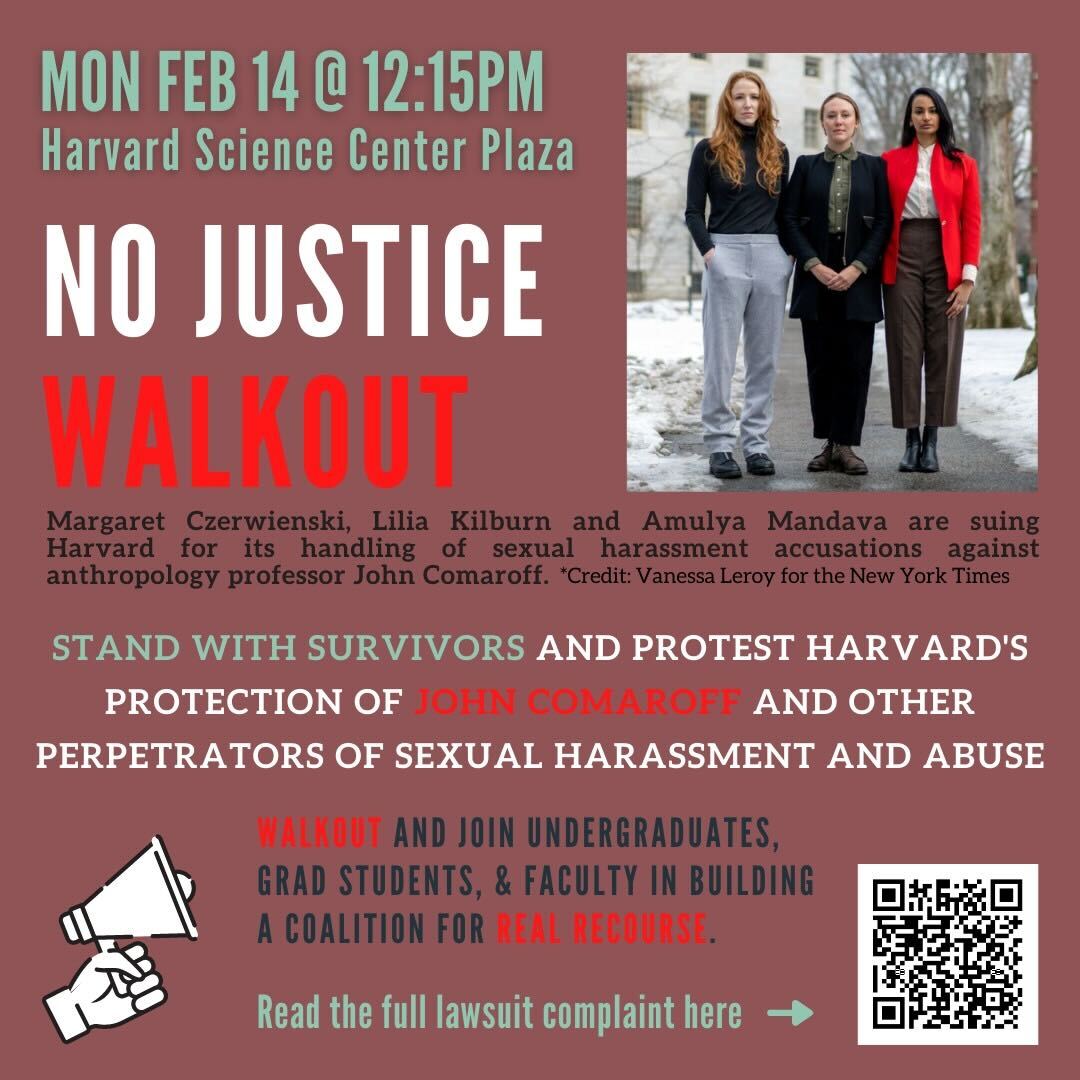
Last February, almost a year ago, we published a long read about the struggle of three anthropology graduate students and their union against alleged sexual harassment at Harvard by Professor John Comaroff. (You can find that article here.) This is a short update.

Continue reading

Me Too: The Economists Organize

Nancy Lindisfarne and Jonathan Neale write:

This short post is to update our readers on the Me Too firestorm that is beginning in economic departments in universities in the United States. [1]

Jennifer Doleac is an associate professor of economics at Texas A&M University. That is to say, she has tenure. Which is good, because on October 20 she sent out a dynamite of a tweet:

Continue reading

Harvard, Sexual Politics, Class and Resistance

A long read by Nancy Lindisfarne and Jonathan Neale

As we write, the case of alleged sexual harassment by John Comaroff, a professor of anthropology at Harvard, is exploding. The Harvard case is particularly egregious, not least because of the elite status of the university.

In this piece we treat the Harvard case as part of a much wider set of problems concerning class, sexual politics, inequality and resistance. Our focus initially is on universities in the United States. But we need to remember that academic enterprise today is utterly international. Everywhere the industry relies on similar economic models, has similar intellectual concerns and fosters the considerable mobility of professionals and students from workplace to workplace around the globe.

We are particularly addressing anthropology and other graduate students in the United States and across the world. Our aim is to try to answer some of the difficult questions that come up again and again in online discussion of the case.

Continue reading

#MeToo and Class Struggle at Work

Rachel Maddow Friday night

Nancy Lindisfarne and Jonathan Neale write: Yesterday we tuned in to watch Rachel Maddow’s nightly one-hour show on the US cable news network, MSNBC. Something extraordinary happened. Twenty minutes into the show Maddow began to talk about the Harvey Weinstein case. Over the next forty minutes she set forth, in powerful and coherent detail, how her bosses had attempted to protect Weinstein from the exposure of his sexual harassment and rapes on NBC News. Maddow accused her bosses, her bosses’ bosses, and her bosses’ bosses’ bosses, of lying, and of actions that were illegal and immoral. On live TV. Continue reading

Blasey Ford, Kavanaugh and seven useful insights about sexual violence

Protest in St Louis, 2 October 2018

Nancy Lindisfarne and Jonathan Neale write: Last Thursday, Christine Blasey Ford testified before the judiciary committee of the US Senate. She said that Brett Kavanaugh, the nominee for the Supreme Court, had attempted to rape her when she was 15. He denied it. She told the truth and he was lying. Everyone in the room knew this, including all eleven Republican senators.

What happened next was something else. The Republican senators rallied to defend the right to rape. Sure, class also mattered, and abortion, and Trump, and the midterm elections. But centrally, they did not want Kavanaugh to pay a price for his sexual violence. An extraordinary moment of #metoo resistance had provoked that Republican backlash, and they closed ranks fast and hard.

When a system is working smoothly the mechanics of power are hidden. But when there is a breakdown, a ‘breach case’, we sometimes have an opportunity to see how the system works. And the links and deep loyalties that keep inequality in place become visible. The hearing has offered such an opportunity. It gives us a chance to formulate seven useful ideas about sexual violence. Continue reading

Michael Kimmel, #MeTooSociology and Feminist Betrayal of Sex Workers in Academia

Juniper Fitzgerald writes: I’ve made an entire alter ego out of the things people hate most about women: bodily autonomy and self-determination in the form of sex work and body modifications, among other things. The recent allegations against prominent sociologist Michael Kimmel, a man known for his scholarship on masculinity and masculine entitlement, unveil the things people love most about women—complicity in the form of apologetics and silence, among other things.

As a former sex worker and sociologist, the allegations against Kimmel sent me spiraling in ways I did not anticipate, and not just because I have repeatedly experienced sexual harassment in my academic career. I am particularly revolted by the allegations against Kimmel because I disavowed my hard-earned sex worker gut feeling in order to elevate his career. Continue reading

Covering up abuse – We are all gymnasts


Rachel Denhollander at the trial of Larry Nasser

Nancy Lindisfarne and Jonathan Neale write: In the wake of Metoo, collective movements are now exposing cover-ups from the top. The target is no longer just one individual, a Strauss-Kahn, a Bill Clinton or a Clarence Thomas. These movements are shouting: it’s a whole system. The class inequalities that protect abuse are being exposed. This is a cause for joy, and hope.

The Larry Nasser case provides a brutal example. At Nasser’s trial last month more than 160 survivors of abuse testified about what he had done to them. Nasser was a doctor for the athletics department at Michigan State University, and for the United States national Olympic team in gymnastics. The stories the survivors told were moving, and horrific. Nasser abused thousands of girls, some as young as six, by fingering them vaginally and anally for his own pleasure, over a period of more than twenty years.

Nasser was only able to do what he did because dozens of people  covered up for him. This fits with what we have seen in the many cases the Metoo movement has begun to expose. Only a minority of men abuse. Most men do not do those things. But the men who do it, do it over and over again, so almost every woman suffers. Continue reading