NANCY LINDISFARNE writes:
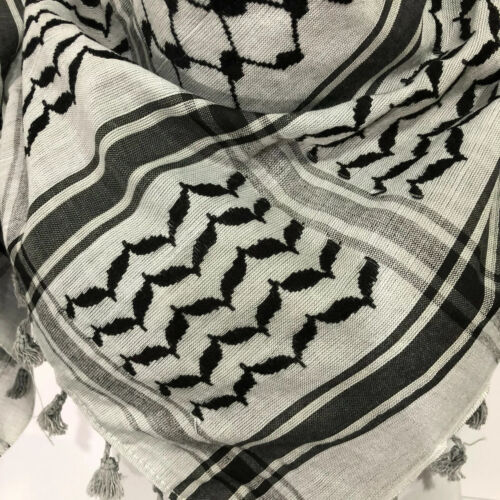
There were two huge Gaza demonstrations in London in October, and after the enormous one in early November, 2023, I started wearing my Palestinian kefiya scarf or my big Free Palestine badge, or both, whenever I went out.
The first day after the demo I walked to our local shops and on the way, my favourite homeless person, Simon, stood up, hugged me and said, ‘We Can’t Let Them Get Us Down’.
I was surprised and deeply touched. I’m white, Simon is black. Neither of us is Palestinian, nor Muslim, nor are either of us from the Middle East. But he’d seen my badge and completely got it. His hug was about solidarity, about empathy and about understanding that ‘There but for the grace of god, go I’.
It was an important moment for me, but things since then have been very strange.
Four months on, where ever I’ve been in London, or around southern England, I see that the only person on the street who is wearing a kafiyeh or a Free Palestinian badge is me.
I remember the intifada that started in 1987 and went on for six years. Then, lots and lots of people, on the streets, and at work, signalled their support. But not now. Not this time round.
And yet – yet – an opinion poll in the UK back in December said that 71% of the population supported a ceasefire, 12% were against a ceasefire, and 18% were undecided. That was already a large majority for a ceasefire and a ceasefire now.
Two months on, at the end of January, the International Court of Justice at the Hague ordered Israel to comply with a range of humanitarian measures or risk a verdict of genocide. And as people watch the continuing horror in real time on their phones, they have become fiercer in their anger and filled with disgust at the equivocation and hypocrisy of politicians on both sides of the political divide.
So why am I the only person signalling this when I walk out to the shops in January?
Why, in February, when 30,000 people, mostly women and children have been killed in Gaza, am I the only person I see wearing my support and my anger on my sleeve as I walk down Oxford Street from Marble Arch and through the crowds at Piccadilly and onto the Strand?
It is not as if people don’t see me. I’m not invisible. People, men and women, catch my eye and bob their head. A waiter leaned down, and said quietly, ‘I’m glad to see that’. As I was leaving a bus, the driver nodded and said, ‘I agree’.
A nice-looking young man walked across the lobby of a theatre in London last week, and with some hesitation he said, ‘I am so glad to see you wearing that pin.’
‘Yes, I think it’s important,’ I said. And then I dared to ask him, ‘Why do you think I am the only one”?
‘I don’t know’, he replied, ‘I really don’t know. I don’t even know about myself. I’ve been on the big demonstrations, I’ve got a Free Palestine badge, I’ve carried placards and a flag, but for every day, you’d never know it.’
He paused and looked at me hard, then said, ‘I think I’m afraid.’ And we both were quiet for a bit.
Then I broke the silence with some energy: ‘Look, I really don’t think you have any reason to be. I haven’t seen any hostility at all. Not one single soul has said anything unpleasant to me, and I’ve been doing this for months.’
And I added, ‘But of course I’m an old woman. I’ve got white hair. Maybe they wouldn’t dare. Or worse, maybe they just think I’m crazy and I’m not worth bothering about. I don’t know what it will be like for a young white guy. Or for a young Muslim woman wearing a hijab, but absolutely nothing bad has happened to me.
‘I am not at all worried walking down the street and I do know that thirty years ago there were a lot of people like me now taking sides. And look at the stats,’ I said, ‘most people here think the way we do. I honestly don’t think you are likely to be risking much.’
‘You’re right’, he said. ‘Thank you. I’m going to start wearing my badge from now on’. And I feel pretty sure he is doing just that.
I didn’t see him after the performance, but two Americans, a couple, came over introduced themselves and asked us what we thought of this production of King Lear. They didn’t mention Gaza, but that’s why they came up to us and started the conversation. And it turned they came to London each spring to go to the theatre, and we agreed that when they came over next year, we’d aim to meet again.
****
The next day – four days ago, in fact – I got on a bus in London and had a memorable ride. It was a long one, from north London to Victoria. I sat in the seat reserved for old people like me who needed to sit down. The bus was crowded and a woman of maybe forty-five or fifty, a bit heavy, laden with shopping, sat down beside me, took one look at me and she said, ‘You’re brave.’
I shook my head. ‘I don’t think so,’ I replied. Then remembering my conversation with the young man, I added, ‘What’s strange is that I’m the only one.’ And I ventured to ask, ‘People are scared now?’

She was quick, the lady sitting next to me. She grimaced and said as fast as lightening, ‘You are right. It wasn’t like this before. And I’m not a person who is afraid’, she said. ‘I’m happy to talk to people, to speak my mind. But I haven’t done anything this time.’
And after a bit, she added, ‘I used to be out there and political all the time.’
‘I know’, I said and let rip a bit of a rant as she was gathering her bags ready to get off, ‘Look at what is coming down from the top. Look at Sunak talking about mob-rule in London, and Gove’s new laws punishing extremism. Look at the climate activists facing jail …’
When she stood to get off, she put her hand on my arm, ‘You know. It’s Brexit. They really are tied to the Americans now – they dare not go against them – neither party. They all do whatever the American say.’
I nodded. I wouldn’t have gotten there that fast. And as she stepped down from the bus she turned, and we each said ‘Take care’, to the other.
One of the very best things about wearing this badge, are the lovely strangers I keep meeting and the conversations that just seem to happen.
****
Two stops along another woman sat down next to me. She was thin, older, wearing rather daring glasses and old lady lipstick. We sat quiet next to each other into Camden Town. But as she moved to get up, she said, ‘Maybe I should be wearing a badge saying ‘Free the Hostages’.
‘Yes, absolutely. That would be good too.’
She looked at me sharply – surprised I think – her eyes magnified by her bi-focals, and she said quickly, ‘We all want peace, don’t we?’
****
And two stops further along, it was another woman, younger, Black British, smiling as she sat down. ‘I like that’, she said. She had invited herself to the seat.
‘Yes.’
‘I’m a teacher’, she said. ‘And the kids are – I don’t know what – so muddled.’
‘What age?’ I asked.
‘Secondary school – geography’, she replied.
‘Are they confused, frightened?’
‘No, it’s something else. Let me try and think of the word.’
‘Cowed’, I offered.
‘No, not quite that’.
And we sat for a while, watching a woman wrestle a big push chair and her sleeping babe off the bus.
‘“Desensitized”– that’s the word’, she said in a eureka moment. ‘They don’t know how to work out what is important and what isn’t. Or why they should care, or how things might connect with them. I don’t how or why it has happened, but it is different.’
I hadn’t expected that, and so I countered, ‘But it’s clear that young people are much angrier about Gaza and about the climate – than us oldies’, I said it with a sheepish shrug, because she wasn’t really very old.
‘Yes, I know, but there is something else too. Us teachers, we talk about it all the time. We know they are disaffected and scared about what’s going to happen next. There is ambient anger, but too much of it seems unfocused, unreasoning.’
She paused. Almost as if she were talking to herself, she said, ‘I think I am furious with so many of them for allowing themselves to be swept along, and for not having any clear politics. They are like docile wolves, or sheep that growl’.
Then she looked straight at me, ‘that’s probably not want you want to hear from a teacher …’
‘Are you kidding?’ I said, ‘I think it’s great’.
‘But I don’t know how or why it has happened. It is different, there is a seething, but a lot of hesitation, of keeping stuff hidden. It is different … I wish I knew how and why.’
It was real puzzlement, and she was so thoughtful, we could have talked on for hours. But she got off at Marble Arch and left me feeling bereft. She could so easily have become a good friend.
****
The last leg of my journey, another long one, was by coach. I was sitting at a table right at the front, looking back. There was a young woman wearing hijab facing me about four seats along on the opposite side of the aisle. I know she saw my badge. And there was another, older woman, also sitting opposite me, but closer. She was a watcher, a person who looks at things and people, so she too must have seen the badge, but she didn’t try to catch my eye.
When we got out of London, the driver turned the lights down inside the coach, and everyone dozed for nearly two hours. It was a very quiet journey until, just as we left the park-and-ride and were coming into the city, a very sharp downpour swept in from the west. The rain pelted down, slashing the windows, drumming on the sides of the bus. And at the next stop, a stocky man, dripping wet, jumped onto the coach to ride the last little way into town.
He sat down panting, smiling, apologetic, clearly feeling rather silly.
‘I had to run’, he said. It’s raining.’
‘I know’, I said, ‘and you are really wet.’
‘Yes.’ He grinned and as he started to settle, he jerked forward and leaned over the little table between us and said, ‘You’re very political’.
‘Do you think so? Because of this?’ I nodded down at my badge.
‘Yes. I stay neutral,’ he replied.
‘Really?’ And I couldn’t resist asking. ‘So you think it is okay that so many people in Gaza – many women and children – are dying?’
‘Killing is wrong. And war is wrong’, he came back robustly. ‘But I stay neutral.‘
‘That doesn’t sound very neutral to me.’
‘But there are always two sides to a story.’
‘Well, yes, but that doesn’t mean both sides are right, does it?’
‘Yes, but there were the attacks in October.’
‘I know. and a lot of people died. But that wasn’t the beginning, was it? There is a long, ugly history to what is happening now.’
‘You mean 1947,’ he said, coming up with the date right away and very fast.
‘Yes, that’s what I mean. And that however you think about that history, to me, what’s happening in Gaza now is horribly wrong.’
‘Yes,’ he said, taking off his glasses to wipe off the last drops of rain, ‘but I stay out things’. And after a pause, he asked, ‘Are you anti-semitic?’
‘No, I absolutely am not.’ As which point I dared to ask that awfully tricky, iffy question. ‘You have an accent. May I ask where you are from?’
‘I’m from China,’ he paused and let that register, and then added quietly, ‘It’s a political country’.
‘I know’, I said. And for the rest of the ride – some fifteen minutes – we talked about jobs, and travel and him having come to the UK to study and working for an American company here for 28 years.
When I got up for my stop, he said, ‘Be careful. It could be dangerous.”
‘Thanks, I said, ‘and you take care’, and out the corner of my eye, I saw the woman in the hijab gave me a quick smile, And the other nearer woman smiled as well. Until that moment, I hadn’t realized they’d both been listening to our every word.
And as I stepped down from the bus, against all the usual conventions, it was the driver who said ‘thank you’ to me. And I understood he’d been listening to our conversation too.
Related Posts
Nancy Lindisfarne and Jonathan Neale, The Meaning of Ceasefire: Gaza, Genocide, Resistance and Climate Change
Takis Geros, Nothing Began in October: Humanitarianism, the Election of Hamas and the Israeli Lockdown of 2006
Nancy Lindisfarne and Jonathan Neale, Palestine and Climate Change: Greta Stands with Gaza
 Anne Bonny Pirate
I thought you might like this… If you wanted a trip to Wales ????
CC is using her voice… In more ways than one.
Thank you for the article x
Sent from Outlook for Androidhttps://aka.ms/AAb9ysg ________________________________
LikeLike
Wonderful piece. Here in Italy kefiyas were fashionable ages ago. Many people might still have theirs in a drawer. Yet you see very few around. I really do not get why.
As I wore mine some colleagues told me that they would be afraid of doing it. Yet, so far, as you described so well, all that I got were just whispered… “thanks”.
LikeLike